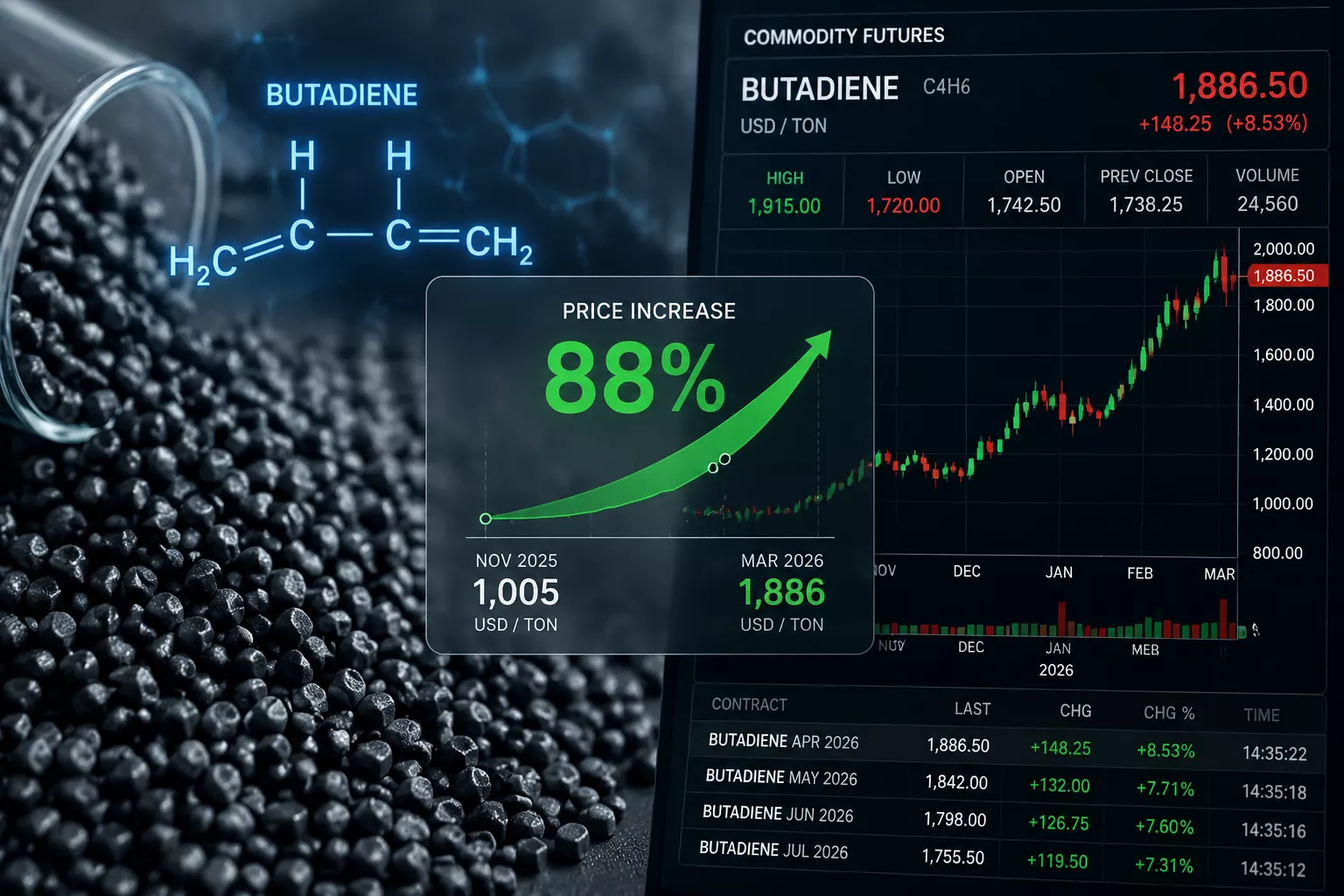
Butadiene prices surged 88% between early November 2025 and March 2026, reaching 12,900 yuan per ton—a cost shock that sent ripples through every nitrile glove manufacturer’s balance sheet. For procurement teams managing disposable glove supply chains in 2026, raw material volatility in nitrile gloves has transformed from a periodic nuisance into a strategic imperative demanding sophisticated hedging strategies against synthetic rubber price swings.
This article examines how volatile synthetic rubber and nitrile butadiene rubber (NBR) costs impact glove pricing and margins, then delivers practical hedging tactics, supplier diversification frameworks, and forecasting tools that procurement professionals can deploy immediately.

Key Takeaways
- Butadiene feedstock costs jumped 88% in early 2026, directly impacting NBR prices and nitrile glove manufacturing margins
- Effective hedging requires layered strategies: commodity-linked pricing formulas, supplier diversification, and flexible procurement timing
- Trade policy amplifies volatility: U.S. tariffs on Chinese gloves reached 100% in 2026, creating additional price pressure beyond raw materials
- Geographic arbitrage opportunities exist: Chinese oversupply in Europe may create 28% price drops, enabling strategic sourcing shifts
- Powder-free nitrile dominates 76% of production, so hedge ratios should reflect mainstream product economics
Understanding Raw Material Volatility in Nitrile Gloves
The Synthetic Rubber Cost Structure
Nitrile gloves depend on nitrile butadiene rubber (NBR), a synthetic polymer derived from butadiene and acrylonitrile. These petrochemical feedstocks represent 40-60% of total manufacturing costs, making glove makers acutely vulnerable to upstream price swings.
The 2026 butadiene spike illustrates this vulnerability perfectly. When feedstock costs nearly double in four months, manufacturers face three unpleasant choices:
- Absorb the cost and sacrifice margins 📉
- Pass through pricing and risk losing volume to competitors
- Hedge exposure through financial or operational strategies
Most successful glove companies in 2026 are choosing option three, implementing sophisticated risk management programs that blend financial instruments with supply chain tactics.
Why NBR Prices Swing So Dramatically
Several structural factors drive raw material volatility in nitrile gloves:
Crude oil dependency 🛢️ – Butadiene is a byproduct of ethylene production from naphtha crackers. When oil prices spike or refinery utilization drops, butadiene supply tightens and prices soar.
Limited supplier concentration – A handful of petrochemical producers control global butadiene capacity, creating oligopolistic pricing power during supply crunches.
Demand competition – Butadiene feeds multiple industries (tires, plastics, adhesives), so glove makers compete for allocation during shortages.
Currency fluctuations – Most NBR trades in U.S. dollars, exposing non-dollar buyers to exchange rate risk on top of commodity risk.
Geopolitical disruption – Trade tensions, sanctions, and tariffs can instantly reshape supply chains and pricing dynamics.
The 2020-2021 period demonstrated extreme volatility when constrained NBR supply drove nitrile glove prices up 300% within nine months. While 2026 conditions are less extreme, the underlying structural vulnerabilities remain.
Hedging Strategies Against Synthetic Rubber Price Swings
Financial Hedging Instruments
Commodity futures and swaps offer direct protection against petrochemical price movements. While no exchange-traded butadiene futures exist, procurement teams can hedge related benchmarks:
- Crude oil futures (WTI, Brent) provide partial correlation since butadiene derives from oil-based feedstocks
- Naphtha swaps offer closer correlation to cracker economics
- Custom OTC swaps linked to regional butadiene indices (available through specialized commodity brokers)
Effectiveness: Financial hedges work best for large-volume buyers who can justify the transaction costs and margin requirements. A 10,000-case monthly buyer might hedge 60-70% of expected butadiene exposure six months forward.
Limitations: Basis risk remains significant—the correlation between crude oil and delivered NBR prices is imperfect, typically ranging from 0.6 to 0.8.
Operational Hedging Strategies
Indexed pricing formulas represent the most practical hedge for mid-sized buyers. Instead of fixed-price contracts, procurement teams negotiate supply agreements with quarterly price resets tied to published petrochemical indices.
Example formula:
<code>Glove Price = Base Manufacturing Cost + (Butadiene Index × 0.45) + (Acrylonitrile Index × 0.15) + Fixed Margin
</code>
This approach transfers raw material risk back to manufacturers while maintaining predictable margin structures. The 0.45 coefficient reflects butadiene’s approximate share of NBR cost.
Supplier diversification reduces concentration risk. The optimal 2026 strategy involves:
- Primary supplier (50-60% volume): Long-term partnership with indexed pricing
- Secondary supplier (25-30% volume): Different geographic region, alternative pricing structure
- Spot market allocation (10-15% volume): Opportunistic buying during price dips
Inventory timing strategies exploit predictable seasonal patterns. Butadiene prices typically soften during refinery maintenance seasons (spring and fall in the Northern Hemisphere). Procurement teams can build strategic inventory during these windows, effectively “hedging” through physical storage rather than financial contracts.
Advanced Forecasting Tools
Petrochemical price monitoring services provide early warning signals:
- ICIS pricing – Weekly butadiene and NBR spot prices across Asia, Europe, and Americas
- S&P Global Platts – Real-time petrochemical assessments and forward curves
- Bloomberg commodity terminals – Integrated price data with correlation analytics
Predictive models combine multiple inputs:
| Input Variable | Weight | Data Source |
|---|---|---|
| Crude oil price | 35% | Futures markets |
| Refinery utilization | 25% | EIA weekly reports |
| Ethylene cracker margins | 20% | Industry publications |
| Regional demand indices | 15% | Trade association data |
| Currency exchange rates | 5% | FX markets |
Sophisticated buyers run monthly scenario analyses, modeling glove costs under different oil price paths and refinery utilization assumptions.

Managing Raw Material Volatility in Nitrile Gloves: Practical Implementation
Building a Hedging Program
Step 1: Quantify exposure 📊
Calculate your monthly NBR consumption in metric tons. For reference, producing 1,000 cases of powder-free examination gloves requires approximately 0.8-1.0 metric tons of NBR, depending on glove weight and thickness.
Step 2: Set hedge ratio targets
Conservative approach: Hedge 40-50% of six-month forward consumption Moderate approach: Hedge 60-70% of three-month forward consumption Aggressive approach: Hedge 80-90% of one-month forward consumption
Step 3: Select instruments
Small buyers (<5,000 cases/month): Focus on indexed supplier contracts Medium buyers (5,000-50,000 cases/month): Combine indexed contracts with selective financial hedges Large buyers (>50,000 cases/month): Full program including futures, swaps, and options
Step 4: Monitor and adjust
Review hedge effectiveness monthly. Calculate the “hedge efficiency ratio”:
<code>Efficiency = 1 - (Actual Cost Variance / Unhedged Cost Variance)
</code>
Target efficiency above 0.70 (meaning your hedges eliminate 70%+ of raw material volatility).
Navigating Trade Policy Volatility
The 100% U.S. tariffs on Chinese nitrile gloves in 2026 demonstrate that raw material volatility in nitrile gloves extends beyond petrochemical costs. Effective hedging strategies must account for:
Geographic sourcing flexibility – Maintain qualified suppliers in at least three countries to pivot quickly when tariffs or trade restrictions emerge.
Tariff pass-through clauses – Negotiate contract language that allows price adjustments if import duties change by more than 10%.
Domestic capacity options – Even at premium pricing, maintaining 10-15% domestic sourcing provides insurance against trade disruptions.
Leveraging Market Dislocations
The anticipated 28% price drop in European markets due to Chinese oversupply creates arbitrage opportunities. Procurement teams should:
✅ Monitor regional price spreads weekly across Asia, Europe, and Americas ✅ Maintain import licenses for multiple regions to capitalize on temporary dislocations ✅ Build relationships with freight forwarders who can execute rapid geographic pivots ✅ Negotiate flexible delivery terms that allow destination changes up to 30 days before shipment
Understanding the composition of nitrile gloves helps procurement teams evaluate quality trade-offs when sourcing from new regions during price dislocations.
Industry Context: Market Growth and Structural Trends
The global rubber gloves market reached USD 13.5 billion in 2026 and is projected to hit USD 22.3 billion by 2034, growing at 9.0% annually. This robust demand growth provides manufacturers some pricing power to offset raw material inflation—but not enough to ignore hedging.
Powder-free nitrile gloves captured 76% of global production in 2023, with output around 180 billion pieces. This dominance means hedge strategies should calibrate to mainstream product economics rather than niche segments.
The healthcare sector’s high demand for nitrile gloves continues driving volume growth, while applications expand into food service, automotive maintenance, and industrial settings where oil resistance and abrasion protection matter.
Market analysts identify unstable raw material prices as contributing approximately 20.4% restraint impact on market growth, reinforcing that hedging is not optional for high-volume manufacturers competing on margin.
Conclusion
Raw material volatility in nitrile gloves represents a persistent structural challenge that demands sophisticated hedging strategies against synthetic rubber price swings. The 88% butadiene price surge in early 2026 demonstrates that procurement teams cannot rely on stable input costs—they must actively manage petrochemical exposure through layered risk management programs.
The most effective approach combines financial hedging (futures, swaps, options) with operational strategies (indexed pricing formulas, supplier diversification, inventory timing) and market intelligence (petrochemical monitoring, predictive modeling, geographic arbitrage).
Actionable Next Steps
- Calculate your NBR exposure in metric tons per month and establish baseline cost volatility metrics
- Negotiate indexed pricing clauses in your next supplier contract renewal, linking prices to published butadiene indices
- Diversify your supplier base across at least three countries to reduce concentration and trade policy risk
- Subscribe to petrochemical price monitoring services (ICIS, Platts, or Bloomberg) for early warning signals
- Build strategic inventory during seasonal price softness (typically spring and fall refinery maintenance periods)
- Review hedge effectiveness monthly and adjust your hedge ratio based on market conditions and forecast accuracy
For procurement teams managing disposable glove supply chains in 2026, mastering these hedging strategies transforms raw material volatility from an uncontrollable threat into a manageable risk—protecting margins while maintaining competitive pricing in a growing global market.