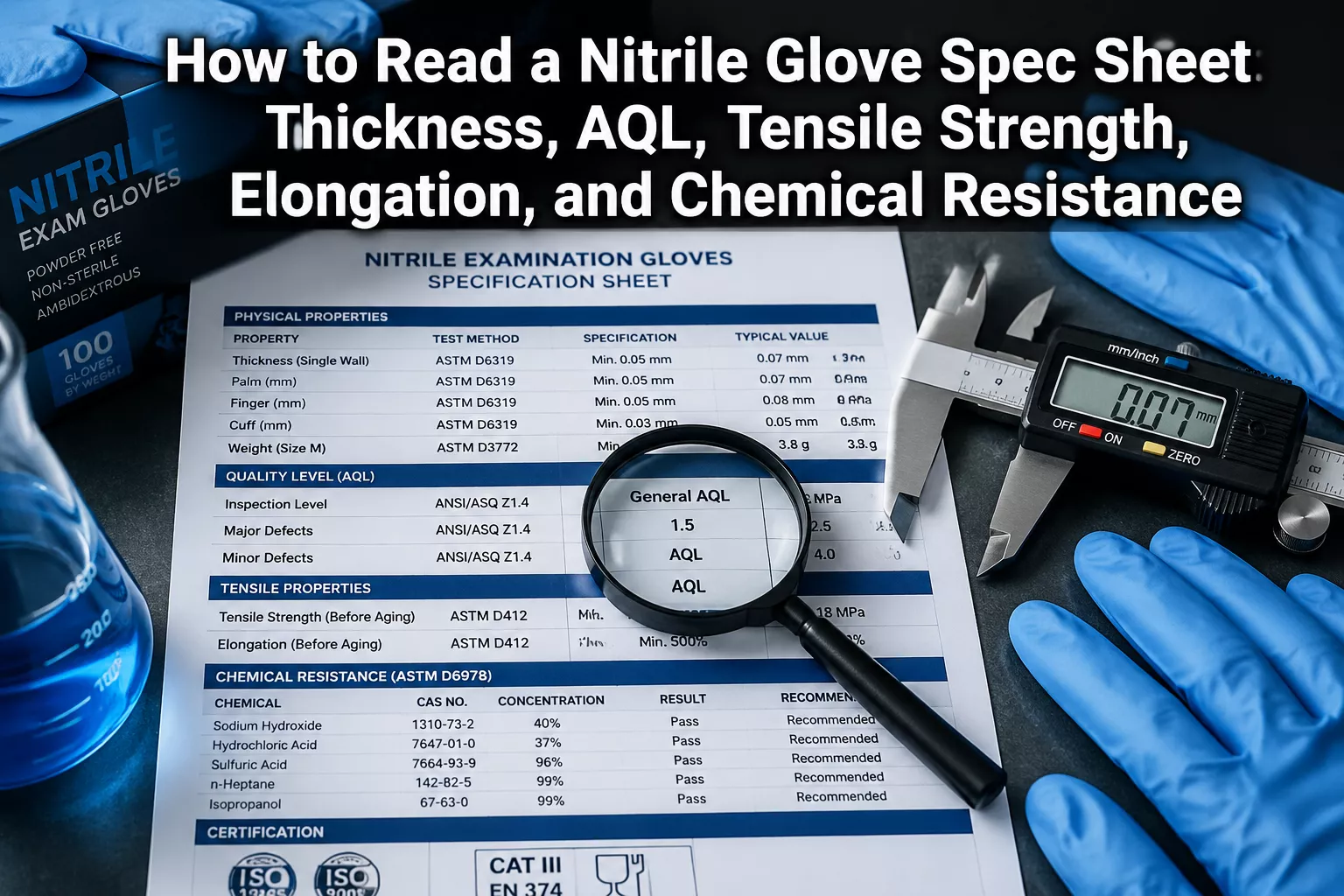
Most buyers waste money on nitrile gloves by chasing the wrong numbers. A procurement manager recently paid 40% more for “8-mil heavy-duty” gloves, only to discover the fingertips were thinner than a competitor’s 6-mil option—and the AQL was worse. Understanding how to read a nitrile glove spec sheet: thickness, AQL, tensile strength, elongation, and chemical resistance can save thousands of dollars and prevent dangerous protection gaps in healthcare, food service, and industrial settings.
Key Takeaways
- Thickness varies by glove area: Palm measurements don’t tell the full story—fingertips and cuffs often differ by 30-50%
- AQL measures defects, not strength: Lower AQL numbers (1.5 or below) indicate better quality control
- Chemical resistance is chemical-specific: A thick glove doesn’t guarantee protection against all substances
- Tensile strength and elongation work together: High elongation (500%+) with adequate tensile strength (14+ MPa) signals durability
- Standards compliance matters most: ASTM D6319 certification for medical use is non-negotiable
Understanding Nitrile Glove Thickness: Beyond the Headline Number
Thickness is the most misunderstood specification on a nitrile glove data sheet. When a manufacturer advertises a “5-mil glove,” that measurement typically refers to palm thickness only—not the entire glove. One mil equals 0.001 inch, so a 5-mil glove measures 0.005 inches at the palm.
Why Palm-Only Measurements Mislead Buyers
Many spec sheets show palm thickness of 0.10 ± 0.02 mm while fingertip thickness reaches 0.16 ± 0.02 mm on the same product. That’s a 60% difference between the advertised number and the area that matters most for tasks requiring precision or puncture protection. For professionals performing tattooing work or detailed laboratory procedures, fingertip thickness determines real-world performance.
Thickness Categories and Their Applications
The 2026 industry standard breaks nitrile gloves into four practical categories:
| Thickness Range | Category | Best Applications | Typical Wear Time |
|---|---|---|---|
| 2–3 mil | Light-duty | Short medical exams, light food prep | 20–30 minutes |
| 4–5 mil | Balanced | General healthcare, food service, light industrial | 30–60 minutes |
| 6–8 mil | Heavy-duty | Chemical handling, automotive, extended tasks | 1–4 hours |
| 9–10 mil | Very heavy-duty | Hazardous material cleanup, industrial chemicals | 4+ hours |
For most healthcare facilities, choosing the right thickness means balancing tactile sensitivity with adequate protection. A hospital setting typically requires 4–5 mil for exam gloves, while janitorial staff need 6–8 mil options.
The Thickness-Puncture Resistance Relationship
Doubling thickness more than doubles puncture resistance in nitrile formulations. A 6-mil glove resists punctures roughly twice as effectively as a 4-mil glove of identical formulation. This nonlinear relationship means small thickness increases deliver significant protection gains—but only if the thickness is consistent across critical areas.
Decoding AQL: The Quality Metric That Actually Matters
Acceptable Quality Level (AQL) measures defect rates in production batches, not glove strength. Lower AQL numbers indicate better quality control. For medical exam gloves, procurement standards demand AQL 1.5 or better, meaning no more than 1.5% of gloves in a sample batch can have pinholes or defects.
What AQL Numbers Really Mean
- AQL 1.5: Medical-grade standard; 1.5 defects per 100 gloves sampled
- AQL 2.5: Industrial acceptable; 2.5 defects per 100 gloves sampled
- AQL 4.0: Lower-grade industrial; not recommended for healthcare or food contact
Some manufacturers advertise thickness while burying AQL data in fine print. A thick glove with AQL 4.0 offers worse barrier protection than a thinner glove at AQL 1.5 because manufacturing defects create immediate breach points.
AQL vs. Standards Compliance
AQL alone doesn’t guarantee performance. Medical-grade nitrile gloves must meet ASTM D6319 standards, which test multiple performance factors beyond defect rates. When reading spec sheets for food handling applications, verify both AQL rating and FDA food-contact approval.
Tensile Strength and Elongation: The Durability Duo
Tensile strength measures how much force a glove can withstand before breaking, reported in megapascals (MPa). Elongation indicates how far the material stretches before failure, expressed as a percentage. These two specifications work together to define real-world durability.
Reading Tensile Strength Values
Quality spec sheets report tensile strength before aging and after aging:
- Medical exam gloves: Minimum 14 MPa before and after aging
- Industrial gloves: 20+ MPa for heavy-duty applications
- Aging performance: Less than 10% strength loss indicates stable shelf life
A glove showing 20 MPa tensile strength with 550% elongation can stretch to 5.5 times its original length while maintaining integrity—ideal for tasks requiring flexibility and toughness, such as automotive work or oil change procedures.
Why Elongation Matters More Than Most Buyers Realize
High elongation (500%+) prevents gloves from tearing during donning and allows natural hand movement. A thick glove with low elongation (below 400%) feels stiff and tears easily at stress points. For beauty and personal care applications requiring repeated hand movements, elongation determines comfort and longevity.
The Aging Test: Shelf Life Indicator
Spec sheets should include “after aging” data showing performance after accelerated aging tests. If tensile strength drops below 80% of original values after aging, the glove may degrade quickly in storage. This matters for bulk buyers maintaining inventory over 6–12 months.
Chemical Resistance: The Most Misunderstood Specification
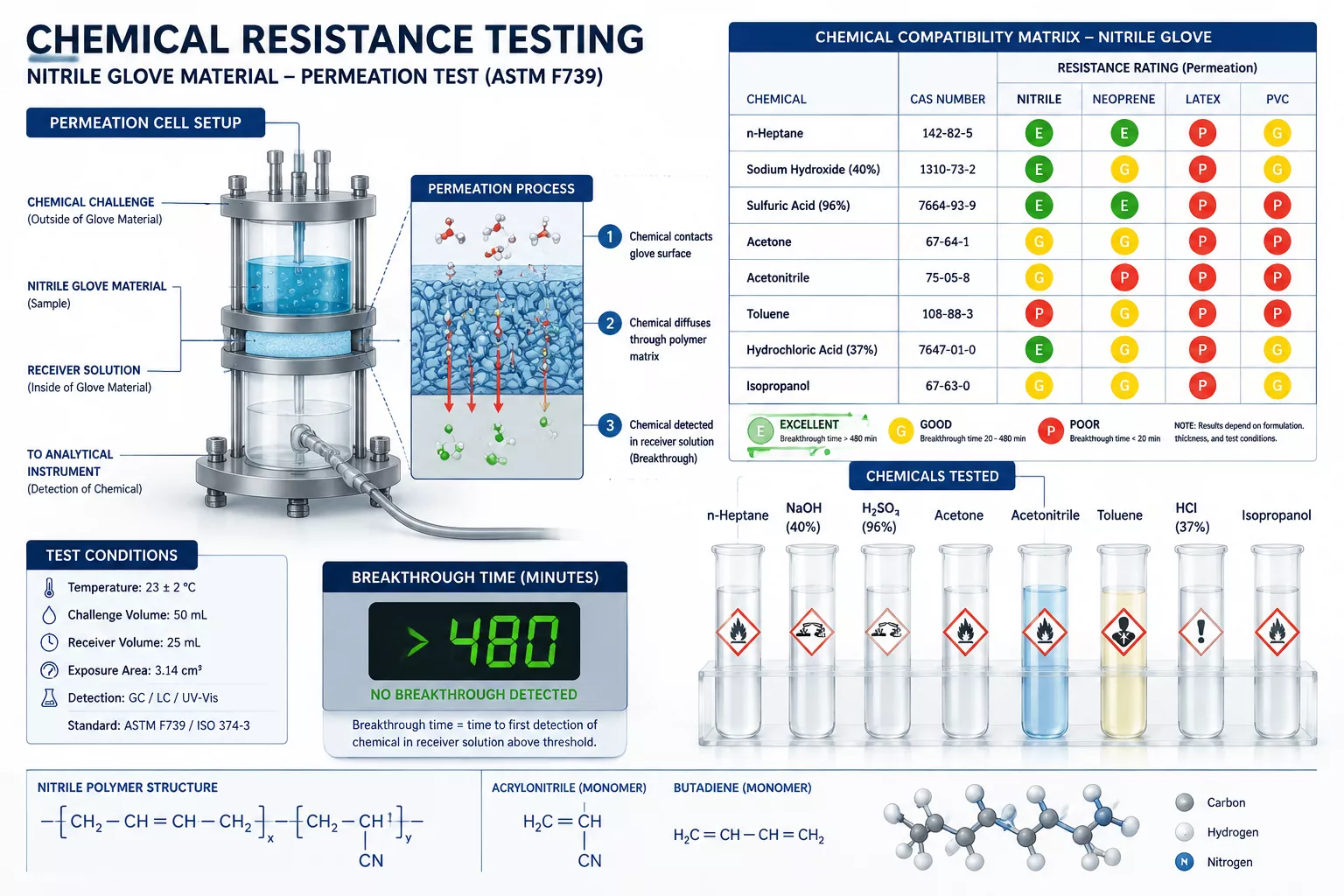
Thickness does not equal universal chemical protection. A 10-mil glove may fail against acetone in minutes while a 6-mil glove with different formulation resists it for hours. Chemical resistance depends on three factors: the specific chemical, nitrile formulation, and exposure conditions.
Breakthrough Time vs. Permeation Rate
Quality spec sheets distinguish between:
- Breakthrough time: How long until the chemical penetrates the glove
- Permeation rate: How quickly the chemical passes through once breakthrough occurs
A 4-mil glove might show breakthrough time that’s a fraction of an 8-mil glove for the same chemical. For petroleum-based oils, nitrile generally excels, but ketones and strong solvents require specific formulation data.
Reading Chemical Compatibility Charts
Comprehensive spec sheets include compatibility ratings:
- ✅ Excellent: 8+ hours breakthrough time
- ⚠️ Good: 1–8 hours breakthrough time
- ❌ Poor: Less than 1 hour breakthrough time
Never assume chemical resistance from thickness alone. Laboratory workers handling specific solvents must verify manufacturer permeation data for their exact chemicals.
Temperature and Concentration Effects
Chemical resistance changes with temperature and concentration. A glove rated “excellent” for 10% acid solution at 20°C may fail rapidly at 50% concentration or elevated temperatures. Spec sheets should note test conditions—if they don’t, request detailed permeation data before purchase.
How to Read a Nitrile Glove Spec Sheet: Your Buyer’s Checklist
A complete spec sheet should answer these questions immediately:
Essential Data Points
✓ Thickness by area
- Palm thickness (in mils or mm)
- Fingertip thickness (often 30–60% thicker)
- Cuff thickness (may be thinner for easier donning)
✓ Quality metrics
- AQL rating (1.5 or lower for medical/food use)
- Standards compliance (ASTM D6319 for medical, FDA for food contact)
- Lot testing frequency
✓ Mechanical properties
- Tensile strength before and after aging (MPa)
- Elongation at break (percentage)
- Puncture resistance (if available)
✓ Chemical resistance
- Specific chemical compatibility chart
- Breakthrough times for relevant chemicals
- Test method references (ASTM F739 or equivalent)
✓ Intended use classification
- Medical exam vs. industrial vs. food service
- Sterile or non-sterile
- Powder-free confirmation
Red Flags in Spec Sheets
Watch for these warning signs:
- Missing AQL data: Suggests quality control issues
- No aging test results: Unknown shelf stability
- Thickness without area specification: Misleading marketing
- Generic “chemical resistant” claims: No specific permeation data
- No standards certification: May not meet regulatory requirements
Application-Specific Selection Guide
Different industries prioritize different specifications when learning how to read a nitrile glove spec sheet: thickness, AQL, tensile strength, elongation, and chemical resistance.
Healthcare and Medical Settings
Priority ranking:
- AQL 1.5 or better + ASTM D6319 compliance
- Adequate thickness (4–5 mil) for barrier protection
- High elongation (500%+) for comfort during extended wear
- Tensile strength 14+ MPa for tear resistance
Medical facilities should verify how long gloves last under typical use conditions and maintain inventory rotation to prevent aging degradation.
Food Service and Preparation
Priority ranking:
- FDA food-contact approval
- AQL 1.5 for barrier integrity
- Balanced thickness (4–5 mil) for dexterity
- Adequate elongation for repeated donning/doffing
Food safety applications require verification that gloves are powder-free and contain no prohibited additives.
Industrial and Chemical Handling
Priority ranking:
- Chemical-specific permeation data for actual workplace chemicals
- Heavy-duty thickness (6–8+ mil) for mechanical protection
- High tensile strength (20+ MPa) for durability
- Extended breakthrough times for relevant chemicals
Industrial buyers should request chemical resistance documentation specific to their workplace hazards rather than relying on generic compatibility charts.
Laboratory and Research
Priority ranking:
- Chemical compatibility with specific lab reagents
- Appropriate thickness for task (3–6 mil for dexterity)
- AQL 1.5 for contamination prevention
- Standards compliance for regulated work
Research settings often require specialized gloves that balance chemical protection with tactile sensitivity for precise work.
Avoiding Common Specification Mistakes
Mistake #1: Comparing Only Headline Thickness
Two “6-mil” gloves from different manufacturers may have completely different fingertip and cuff thicknesses. Always request full thickness profiles before bulk ordering.
Mistake #2: Ignoring AQL for “Heavy-Duty” Claims
A thick glove with poor AQL offers less protection than a thinner glove with better quality control. Manufacturing defects create immediate barrier failures regardless of material thickness.
Mistake #3: Assuming Thickness Equals Chemical Protection
Chemical resistance depends on formulation and the specific chemical, not thickness alone. A thin glove with appropriate formulation may outperform a thick glove against certain substances.
Mistake #4: Overlooking Aging Performance
Gloves that test well when fresh may degrade rapidly in storage. Verify “after aging” tensile strength and elongation data to ensure shelf stability.
Mistake #5: Skipping Standards Verification
Generic “exam gloves” without ASTM certification may not meet regulatory requirements for medical or food-contact use. Always verify applicable standards compliance.
Conclusion
Learning how to read a nitrile glove spec sheet: thickness, AQL, tensile strength, elongation, and chemical resistance transforms purchasing from guesswork into informed decision-making. The most expensive glove isn’t always the best choice—the right glove matches specifications to actual workplace requirements.
Take these action steps today:
- Request complete spec sheets from current suppliers, including thickness by area, AQL, tensile/elongation data, and chemical compatibility charts
- Audit current glove inventory against actual task requirements—you may be overpaying for unnecessary thickness or under-protecting workers with inadequate chemical resistance
- Create application-specific selection criteria for healthcare, food service, and industrial use cases in your organization
- Verify standards compliance for all medical and food-contact gloves, ensuring ASTM D6319 or FDA approval as appropriate
- Test competing products using real workplace conditions before committing to bulk orders
The difference between a $0.08 glove and a $0.12 glove may seem small, but multiply that across thousands of gloves annually and the impact becomes significant—especially if the cheaper option actually performs better for your specific needs. Smart spec sheet reading puts that money back in your budget while improving worker protection and satisfaction.