Between July and November 2020, nitrile glove prices surged by nearly 40%, with U.S. import costs from Malaysia jumping from $0.03 per glove to unprecedented levels. Yet by late 2020, the market had already begun its dramatic reversal—excess stockpiles appeared, and the industry faced a new challenge: oversupply after panic buying. This whiplash exposed critical vulnerabilities in Nitrile Glove Supply Chain Resilience: Lessons from Post-Pandemic Oversupply and Strategic Inventory Planning for 2026-2035 that procurement teams must address today.
The pandemic created a perfect storm: factory shutdowns, export restrictions, and skyrocketing demand collided with aggressive capacity expansions that eventually flooded markets. As businesses navigate 2026 and plan through 2035, understanding how the industry overcorrected—and how to balance supply security with cost efficiency—has become essential for sustainable procurement strategies.
Key Takeaways
✅ Post-pandemic overcorrection created capacity gluts after initial shortages, causing price volatility that demands smarter inventory buffers in 2026
📊 Diversified sourcing across Malaysia, China, and emerging U.S. production reduces dependency risks while managing cost fluctuations through 2035
🤖 AI-powered inventory management enables real-time demand forecasting to prevent both stockouts and excess inventory accumulation
💰 Strategic prepayment models secure supply during tight markets but require careful balance to avoid oversupply exposure
🌍 Market growth projections show 7.9% CAGR through 2032, signaling sustained demand that justifies long-term planning investments
The Pandemic Whiplash: From Shortage to Surplus
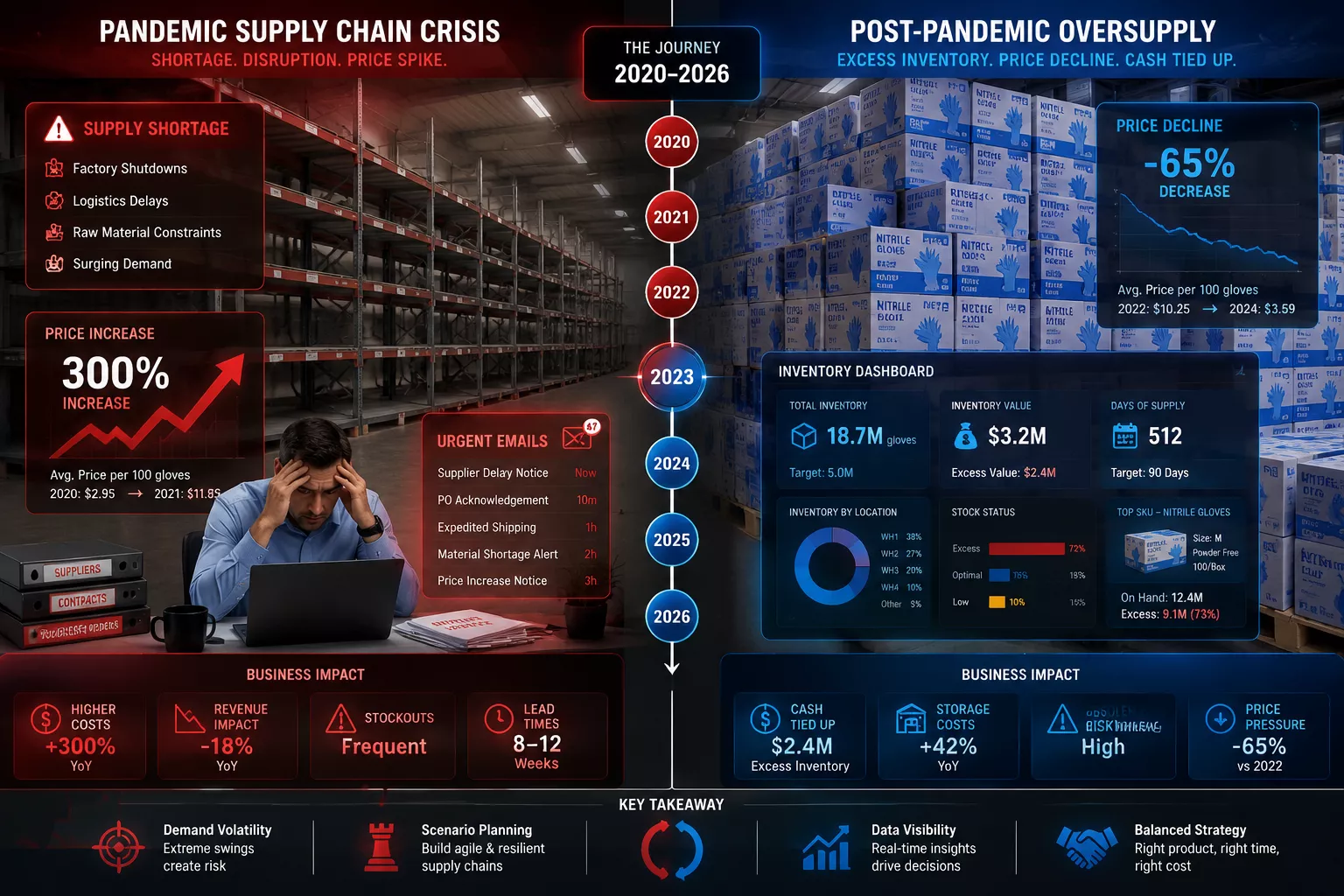
The COVID-19 pandemic exposed how quickly nitrile glove supply chains could collapse. In early 2021, Malaysian manufacturer Top Glove—responsible for a significant portion of global production—shuttered 28 factories due to COVID-19 outbreaks. Deliveries faced 2-4 week delays, and prices climbed relentlessly.
The Shortage Phase: What Went Wrong
Several factors converged to create the crisis:
- Production slowdowns from factory closures and labor shortages
- Export restrictions from key producing nations protecting domestic supplies
- Demand spikes exceeding 300% in healthcare and industrial sectors
- Supply chain bottlenecks in shipping and logistics networks
MSC Industrial’s experience illustrates the challenge. Since September 2020, the company prepaid for nitrile gloves to secure supply—a deviation from normal procurement processes. CEO Erik Gershwind noted that nitrile gloves proved uniquely challenging compared to other PPE, requiring strategic stockpiling approaches that many organizations weren’t prepared to implement.
The Overcorrection: When Supply Exceeded Demand
By late 2020, the market began shifting. Manufacturers ramped up capacity aggressively, and buyers hoarded inventory. MSC Industrial’s CFO reported that mask prices dropped significantly by October 2020, signaling the first signs of oversupply. Companies like Fastenal found themselves with excess N95 stockpiles, a pattern that would repeat with nitrile gloves.
The lesson for 2026-2035? Supply chains that swing from extreme shortage to surplus create procurement nightmares. Organizations need dynamic inventory strategies that can adapt to rapid market changes rather than reactive panic buying or excessive stockpiling.
Strategic Inventory Planning for Nitrile Glove Supply Chain Resilience: 2026-2035 Framework

Building resilience requires moving beyond traditional just-in-time models without falling into the trap of excessive inventory. Here’s how organizations can navigate the volatile landscape through 2035:
1. Multi-Sourcing Strategy 🌐
Geographic diversification emerged as a critical lesson. China’s market share in U.S. nitrile glove imports grew from 13% to 19% between July and late 2020, demonstrating the value of alternative suppliers. For 2026-2035 planning:
- Primary suppliers: Maintain relationships with established Malaysian producers (Top Glove, Hartalega, Kossan)
- Secondary sources: Develop Chinese supplier partnerships for cost flexibility
- Tertiary options: Monitor emerging U.S. domestic production (Glove Co. LLC, American Nitrile LLC)
While U.S. production capacity remains small compared to monthly imports exceeding 5 billion gloves, domestic options provide strategic buffers during international supply disruptions.
2. AI-Powered Demand Forecasting 🤖
Artificial intelligence is transforming inventory management for nitrile gloves used across industries. Advanced systems now enable:
- Real-time demand pattern recognition across healthcare, food service, and industrial sectors
- Predictive analytics for seasonal fluctuations and emergency spikes
- Automated reorder triggers that balance cost optimization with supply security
- Quality control integration ensuring consistent product standards
Organizations implementing AI-driven inventory systems report 20-30% reductions in excess stock while maintaining higher service levels during demand surges.
3. Flexible Inventory Buffer Models 📦
The optimal inventory strategy for 2026-2035 combines three buffer tiers:
| Buffer Tier | Coverage Period | Purpose | Cost Impact |
|---|---|---|---|
| Working Stock | 30-45 days | Daily operations | Baseline cost |
| Safety Buffer | 60-90 days | Market volatility protection | +15-20% holding costs |
| Strategic Reserve | 90-180 days | Crisis response capacity | +25-35% holding costs |
This tiered approach prevents both stockouts and the capital waste of excessive inventory. Organizations should adjust buffer levels based on usage patterns, supplier reliability scores, and market volatility indicators.
4. Contract Structure Innovation 💼
Post-pandemic procurement requires new contract frameworks:
- Hybrid pricing models: Combine fixed-price agreements (60-70% of volume) with spot market purchases (30-40%) to balance cost predictability and market opportunity
- Prepayment with delivery flexibility: Secure supply commitments while negotiating extended delivery windows to avoid forced oversupply
- Volume corridors: Establish minimum and maximum purchase commitments with price adjustments, protecting both parties from extreme market swings
5. Quality Assurance Integration 🔍
As supply chains diversify, maintaining consistent quality becomes critical. Organizations should verify that suppliers meet standards for composition and chemical resistance properties, especially when sourcing from new manufacturers.
Market Outlook: Demand Drivers Through 2035
Understanding long-term demand trends informs strategic inventory planning. The global nitrile gloves market reached $5.4 billion in 2025 and projects 7.9% annual growth through 2032. Key drivers include:
- Healthcare expansion: Aging populations and increased safety standards drive sustained medical demand
- Industrial growth: Manufacturing and food service sectors maintain elevated PPE usage post-pandemic
- Regulatory requirements: Stricter workplace safety mandates increase baseline consumption
- Latex allergy awareness: Continued shift from latex to nitrile alternatives for allergy-sensitive users
North America holds 37% market share in 2025, while Asia-Pacific shows the fastest growth trajectory through 2035. This geographic distribution suggests procurement strategies should maintain strong Asian supplier relationships while developing regional alternatives.
The medical nitrile/PVC gloves segment specifically projects growth from $9.81 billion in 2025 to $14.88 billion by 2034—a 6.3% CAGR that justifies long-term supply partnerships and capacity investments.
Navigating Tariff Policies and Trade Dynamics
As of January 2026, U.S. disposable glove markets face ongoing tariff impacts and policy volatility. Organizations must:
- Monitor trade policy changes affecting Malaysian and Chinese imports
- Calculate total landed costs including tariffs, shipping, and currency fluctuations
- Evaluate domestic production viability as U.S. capacity gradually expands
- Build tariff contingencies into pricing models and supplier negotiations
Strategic inventory buffers become even more valuable when tariff policies can shift procurement costs by 10-25% with minimal notice.
Practical Implementation: 90-Day Action Plan
Organizations seeking to implement Nitrile Glove Supply Chain Resilience: Lessons from Post-Pandemic Oversupply and Strategic Inventory Planning for 2026-2035 should follow this roadmap:
Days 1-30: Assessment Phase
- Audit current inventory levels and usage patterns
- Evaluate existing supplier concentration risks
- Calculate optimal buffer levels for your organization
- Review contract terms and pricing structures
Days 31-60: Strategy Development
- Identify and qualify alternative suppliers in different regions
- Implement demand forecasting tools or upgrade existing systems
- Design tiered inventory buffer model
- Develop new contract templates with flexibility provisions
Days 61-90: Execution Launch
- Initiate supplier diversification discussions
- Establish AI-powered inventory monitoring systems
- Build strategic reserve inventory to target levels
- Train procurement teams on new protocols
Conclusion
The nitrile glove industry’s journey from shortage to oversupply taught expensive lessons about supply chain resilience. Organizations that simply reacted—panic buying during shortages, then cutting orders during gluts—paid premium prices and still faced supply disruptions.
Nitrile Glove Supply Chain Resilience: Lessons from Post-Pandemic Oversupply and Strategic Inventory Planning for 2026-2035 requires a fundamentally different approach: intelligent diversification, AI-powered forecasting, flexible inventory buffers, and innovative contract structures that adapt to market volatility rather than amplify it.
As the market grows toward $14.88 billion by 2034, procurement teams that implement these strategies will secure reliable supply at optimized costs while competitors continue riding the boom-bust cycle. The question isn’t whether another supply disruption will occur—it’s whether your organization will be prepared when it does.
Take action now: Assess your current nitrile glove inventory strategy against the framework outlined above. Identify your biggest vulnerability—whether it’s supplier concentration, inadequate buffers, or rigid contracts—and address it before the next market shock arrives. For organizations using nitrile gloves across diverse applications, from healthcare to industrial settings, resilient supply chains aren’t optional—they’re essential for operational continuity through 2035.