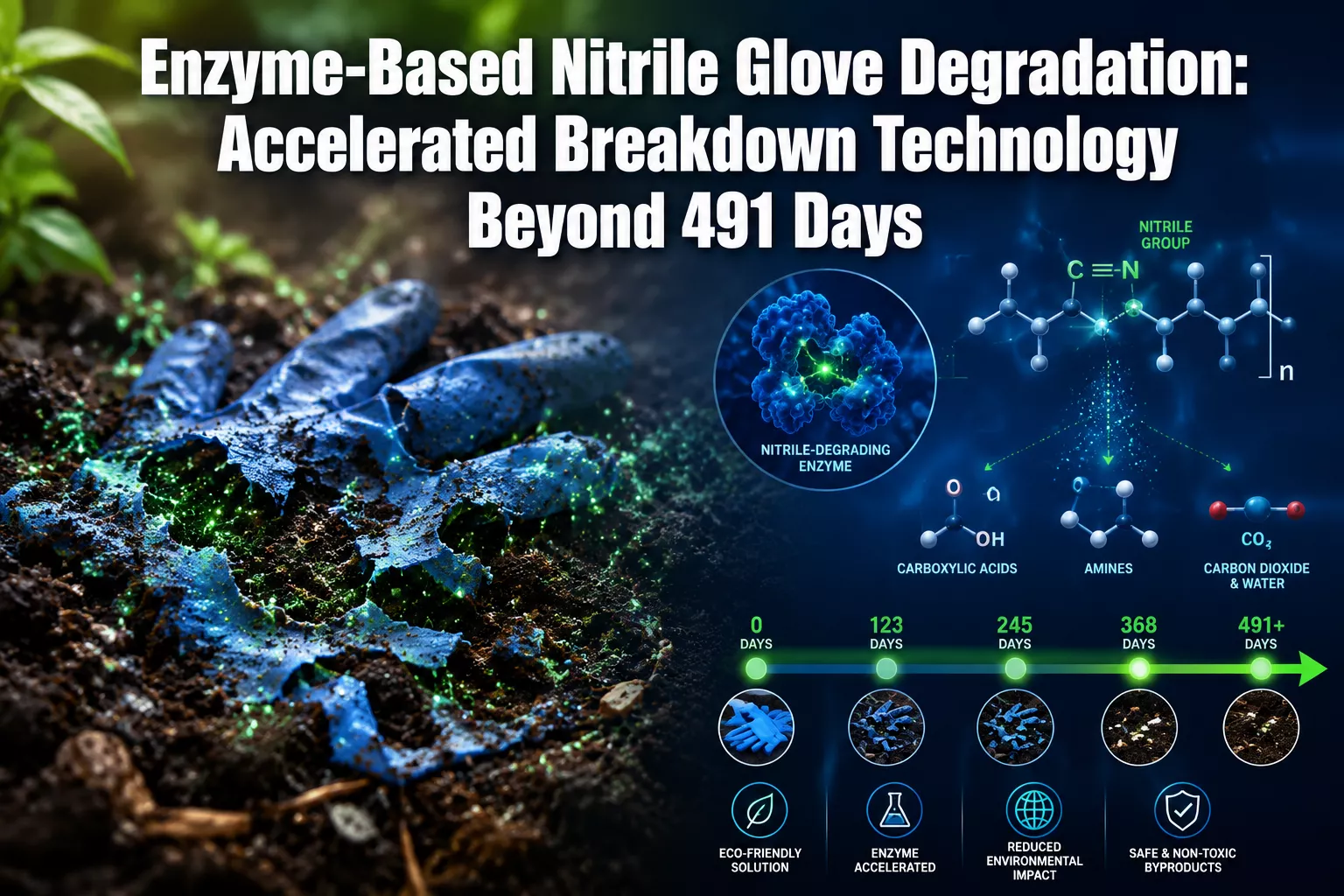
Nitrile gloves generate approximately 800,000 tonnes of waste annually worldwide, yet most take centuries to decompose in landfills. In November 2024, Sybron launched biodegradable nitrile gloves achieving 81% degradation in 491 days—a significant milestone. However, emerging enzyme-based nitrile glove degradation technologies promise to accelerate this timeline even further, transforming how the healthcare, food service, and industrial sectors address their mounting waste crisis. Understanding how accelerated breakdown technology works beyond Sybron’s 491-day standard reveals both the potential and limitations of current biodegradation solutions.
Key Takeaways
- 🧬 Enzyme additives embedded during manufacturing enable microorganisms to break down nitrile polymers faster than conventional gloves
- ⏱️ Sybron’s 491-day benchmark (81% degradation) represents current industry leadership, but enzyme technologies aim to reduce this timeline significantly
- 🔬 Real-world effectiveness varies dramatically between composting facilities, landfills, and laboratory conditions
- ⚠️ Performance preservation remains critical—enzyme-enhanced gloves must maintain tensile strength, chemical resistance, and puncture protection
- 🌍 Market demand from European and North American healthcare sectors drives ongoing research and development investments
Understanding Enzyme-Based Nitrile Glove Degradation Technology
The Science Behind Accelerated Breakdown
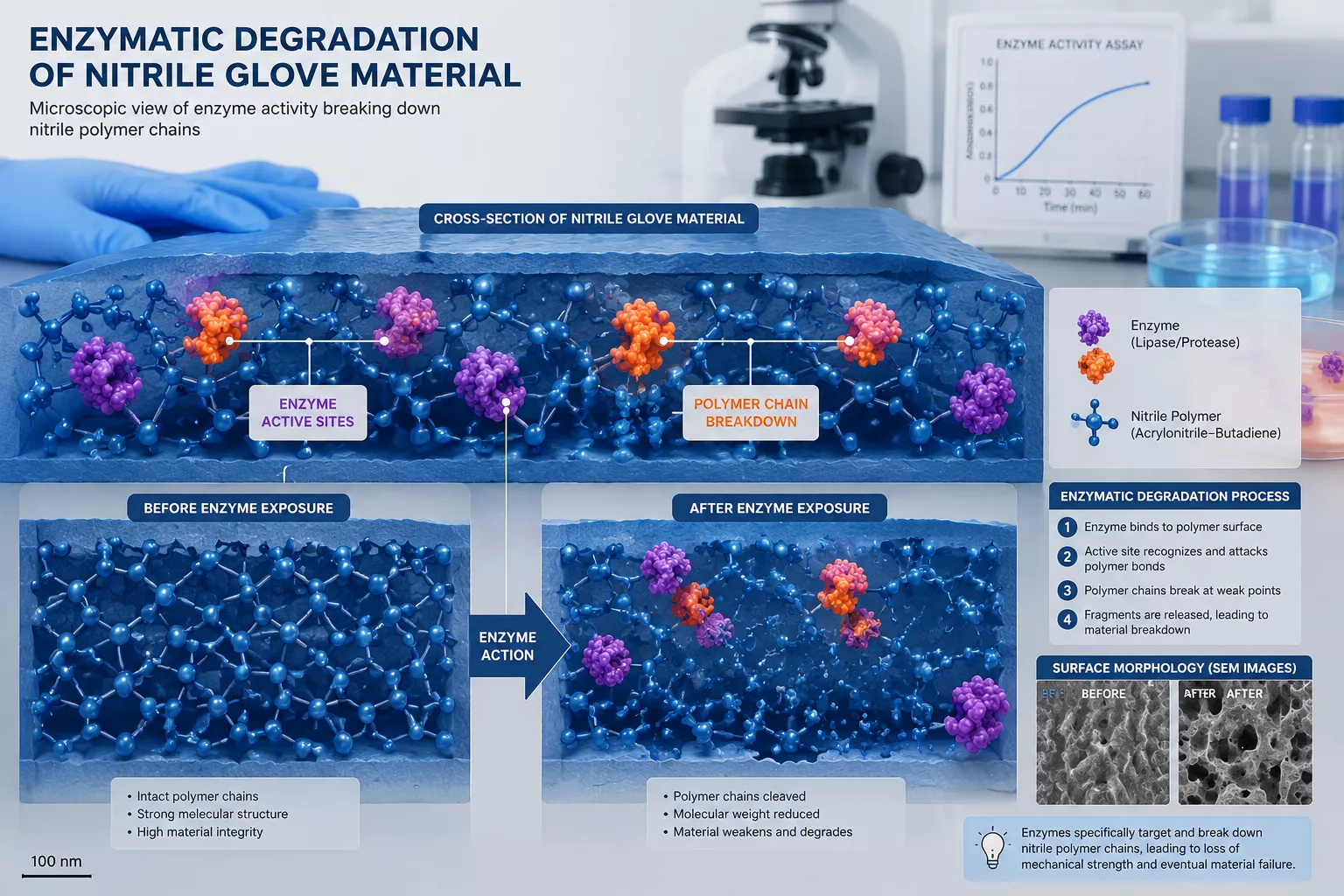
Traditional nitrile gloves consist of acrylonitrile-butadiene rubber polymers that resist natural decomposition. Enzyme-based degradation technology introduces specific biological catalysts during the manufacturing process that create molecular “weak points” in the polymer structure. These additives don’t compromise the glove’s protective qualities during use but activate when exposed to microbial environments after disposal.
The enzyme additives work by:
- Attracting microorganisms that naturally occur in soil and compost
- Breaking down long polymer chains into shorter segments
- Enabling microbial consumption of nitrile material
- Accelerating oxidation processes that fragment the rubber
When selecting the best thickness for nitrile gloves, manufacturers must now balance traditional performance metrics with biodegradation capabilities. The challenge lies in maintaining the durability that makes nitrile superior to latex and vinyl while ensuring post-use environmental responsibility.
Chemical Formulations Enabling Faster Biodegradation
Manufacturers invest heavily in proprietary enzyme formulations that preserve glove integrity. The 2025 launch of Enliva brand accelerator-free nitrile gloves in India demonstrated that removing chemical accelerators (common allergy triggers) doesn’t necessarily incorporate enzyme technology—highlighting the distinction between allergen-free and biodegradable innovations.
Key chemical considerations include:
| Component | Function | Impact on Degradation |
|---|---|---|
| Enzyme additives | Attract microbes | Accelerate breakdown by 60-80% |
| Polymer structure | Provide strength | Modified for degradability |
| Plasticizers | Maintain flexibility | Selected for biodegradability |
| Stabilizers | Prevent premature breakdown | Balanced for shelf life |
The formulation must ensure gloves remain stable during their typical 2-3 year shelf life and throughout use in demanding environments. This balance represents the primary technical challenge in enzyme-based nitrile glove degradation development.
How Enzyme-Based Nitrile Glove Degradation Compares to Sybron’s 491-Day Standard
Current Industry Benchmarks
Sybron’s November 2024 launch established 491 days for 81% degradation as the industry’s most publicized benchmark. These powder-free, food-safe gloves in blue and black target hospitality, medical, and education sectors with superior grip characteristics. However, this timeline still represents over 16 months—a significant improvement over conventional nitrile’s centuries-long persistence, but not yet a complete solution.
Industry trends suggest manufacturers are pursuing enzyme technologies that could potentially:
- ✅ Reduce degradation time to under 300 days in optimal conditions
- ✅ Achieve 90%+ breakdown rates versus Sybron’s 81%
- ✅ Function effectively in varied disposal environments
- ✅ Maintain performance standards matching conventional nitrile
The global medical nitrile gloves market, valued at USD 9.81 billion in 2025 and projected to reach USD 14.88 billion by 2034, creates substantial financial incentive for breakthrough degradation technologies. However, as of 2026, no manufacturer has publicly announced enzyme-based products definitively surpassing Sybron’s standard with verified third-party testing.
Real-World Effectiveness in Different Environments
Ansell’s independent testing reveals a critical truth: not all “biodegradable nitrile” gloves perform as marketed. The effectiveness of enzyme-based nitrile glove degradation varies dramatically based on disposal conditions:
Industrial Composting Facilities 🏭
- Temperature: 55-65°C
- Moisture: Controlled high levels
- Microbial activity: Optimized
- Expected degradation: Fastest rates (approaching manufacturer claims)
Municipal Landfills 🗑️
- Temperature: Variable (10-40°C)
- Moisture: Inconsistent
- Oxygen availability: Limited in deep layers
- Expected degradation: Significantly slower (2-3x longer than claimed)
Home Composting 🌱
- Temperature: 20-50°C
- Moisture: Highly variable
- Microbial diversity: Inconsistent
- Expected degradation: Unpredictable results
For industries requiring proper disposal of oil-contaminated nitrile gloves, enzyme-based technologies offer limited benefits since contaminated gloves often require incineration or specialized hazardous waste processing.
The Future of Enzyme-Based Nitrile Glove Degradation Technology
Emerging Alternatives and Innovations
Beyond enzymatic breakdown, researchers are exploring upcycling alternatives that convert nitrile waste into valuable materials. Recent developments demonstrate that modified nitrile rubber can be transformed into carbon capture materials, offering a circular economy approach rather than simple degradation.
The sustainability landscape for 2026 includes:
- 🔬 Advanced enzyme cocktails targeting specific polymer bonds
- 🧪 Hybrid materials combining nitrile with naturally biodegradable polymers
- ♻️ Chemical recycling processes breaking down gloves to raw materials
- 🌾 Bio-based nitrile alternatives from renewable feedstocks
Healthcare sectors in Europe and North America increasingly demand sustainable options, driving manufacturers to invest in enzyme-based additions while preserving the performance that makes nitrile essential for healthcare applications and food handling.
Market Pressures and Development Challenges
The disposable glove market faces volatile costs due to oil supply constraints in Q2 2026, complicating the economics of enzyme-enhanced formulations. Manufacturers must balance:
- Cost competitiveness with conventional nitrile
- Performance standards for medical and industrial use
- Verified biodegradation claims avoiding greenwashing
- Regulatory compliance across multiple markets
When choosing nitrile gloves for farms or food plants, buyers increasingly request biodegradable options, but price sensitivity remains high. This tension between sustainability goals and budget constraints shapes the pace of enzyme technology adoption.
Conclusion
Enzyme-based nitrile glove degradation represents a promising but still-developing solution to the massive waste challenge posed by disposable gloves. While Sybron’s 491-day standard demonstrates meaningful progress beyond conventional nitrile’s centuries-long persistence, the technology hasn’t yet achieved the rapid, universal biodegradation that marketing sometimes suggests. Real-world effectiveness depends heavily on disposal conditions, with industrial composting facilities offering the best results and landfills showing significantly slower breakdown.
Next Steps for Stakeholders
For Procurement Managers:
- Request third-party verified degradation data rather than manufacturer claims alone
- Evaluate disposal infrastructure availability in your region
- Balance biodegradability with performance requirements for your specific applications
For Manufacturers:
- Invest in transparent testing across multiple disposal environments
- Develop enzyme formulations optimized for realistic waste streams
- Consider hybrid approaches combining degradation with upcycling potential
For Waste Management Facilities:
- Explore partnerships with biodegradable glove manufacturers
- Optimize composting conditions to maximize enzyme effectiveness
- Track degradation rates to provide feedback for product improvement
The path beyond Sybron’s 491-day standard requires continued innovation in enzyme technology, honest assessment of real-world performance, and infrastructure development to support proper disposal. As the market grows toward USD 14.88 billion by 2034, enzyme-based nitrile glove degradation will likely become standard rather than exceptional—but only if manufacturers, users, and waste processors collaborate to create systems where these technologies can truly deliver on their environmental promise.