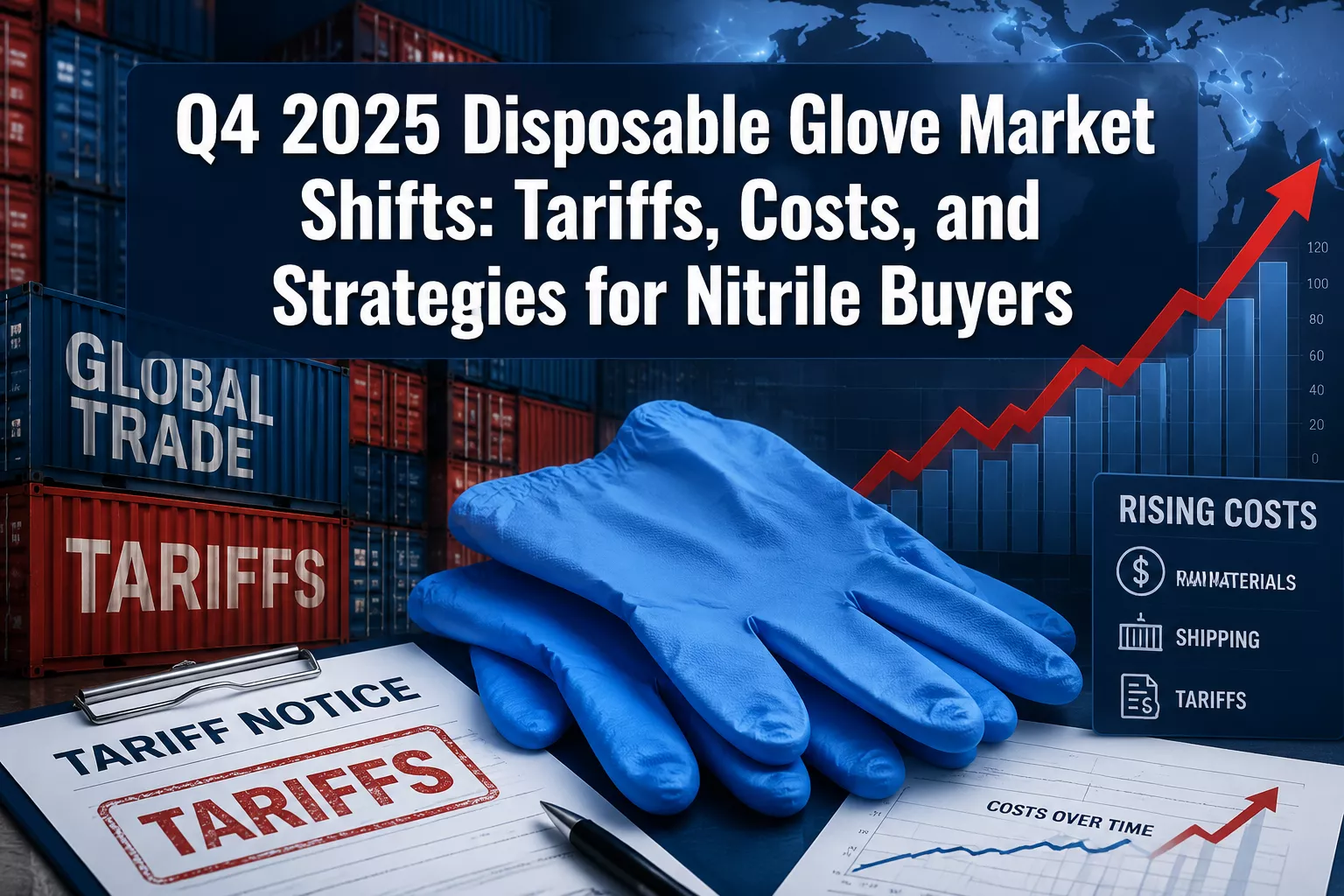
By the fourth quarter of 2025, U.S. tariffs on Chinese nitrile gloves had skyrocketed to 195%, effectively eliminating the world’s largest supplier from the American market overnight. This seismic shift in trade policy created unprecedented volatility in disposable glove pricing, forcing buyers across healthcare, food service, and industrial sectors to completely rethink their procurement strategies. Understanding the Q4 2025 Disposable Glove Market Shifts: Tariffs, Costs, and Strategies for Nitrile Buyers has become essential for any organization dependent on personal protective equipment.
The disposable glove landscape entering Q4 2025 looks dramatically different than just 18 months prior. What began as incremental tariff adjustments evolved into a full-scale supply chain transformation, with ripple effects touching every aspect of nitrile glove procurement—from raw material costs to delivery timelines.
Key Takeaways
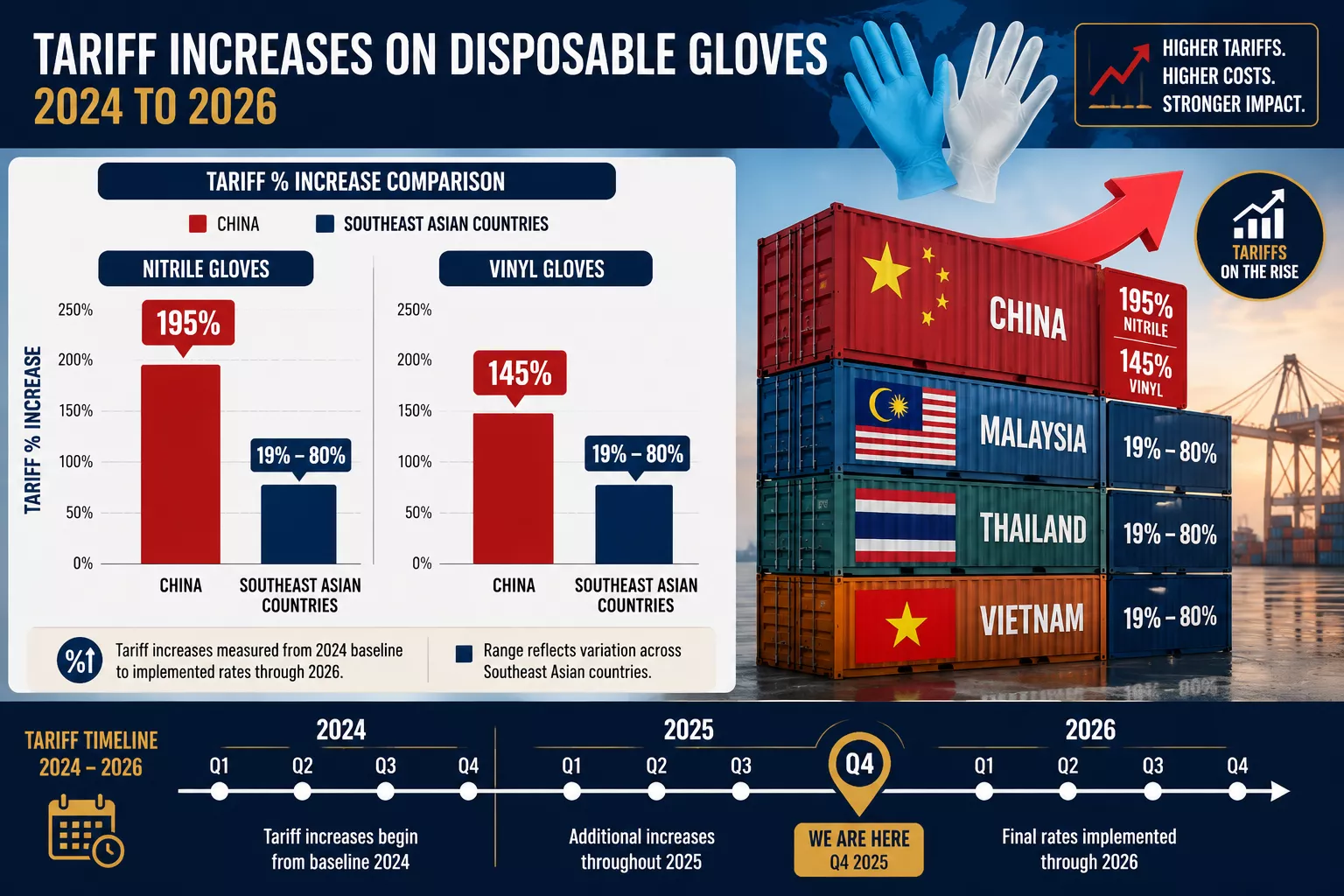
- Tariffs on Chinese nitrile gloves reached 195% by Q4 2025, making them economically unviable and forcing massive supply shifts to Southeast Asia
- Raw material costs for NBR (nitrile butadiene rubber) climbed significantly due to competition from tire and industrial sectors, driving Q4 price increases
- China’s market share plummeted from 38.9% to just 2.8% in medical glove imports, creating capacity constraints and longer lead times
- Strategic buyers are bypassing traditional distributors and sourcing directly from Malaysian, Thai, and Vietnamese manufacturers to control costs
- Vinyl gloves face similar disruption with 145% tariffs on Chinese imports, pushing buyers toward nitrile alternatives despite higher prices
Understanding the Tariff Landscape in Q4 2025
The tariff environment surrounding Q4 2025 Disposable Glove Market Shifts: Tariffs, Costs, and Strategies for Nitrile Buyers represents the most aggressive trade policy shift in the PPE sector’s history.
The China Factor 🚫
Chinese manufacturers, who once dominated global disposable glove production, faced crushing tariff rates by late 2025:
- Medical-grade nitrile gloves: 50% in January 2025, jumping to 100% by January 2026
- General nitrile gloves: 195% by April 2025
- Vinyl gloves: 145% tariffs, rendering them equally uncompetitive
- Additional 10% levy on all Chinese imports starting February 4, 2025
These compounding tariffs created a “tax-on-tax” effect that made Chinese gloves cost-prohibitive. For context, a box of nitrile gloves that cost $8 before tariffs could land at over $20 after all duties were applied.
The Southeast Asian Surge 📈
As Chinese imports collapsed, Southeast Asian manufacturers absorbed the demand:
| Country | Pre-2025 Market Share | Q4 2025 Market Share | Tariff Rate |
|---|---|---|---|
| Malaysia | 22% | 41% | 19-35% |
| Thailand | 15% | 28% | 25-45% |
| Vietnam | 8% | 18% | 30-50% |
| China | 39% | 3% | 195% |
This dramatic reallocation strained manufacturing capacity across the region. Malaysian and Thai factories, already operating near full capacity, struggled to scale production quickly enough to meet surging U.S. demand entering Q4 2025.
When choosing nitrile gloves, buyers now must factor in not just quality and specifications, but also country of origin and associated tariff implications.
Cost Pressures Beyond Tariffs
The Q4 2025 Disposable Glove Market Shifts: Tariffs, Costs, and Strategies for Nitrile Buyers extend well beyond import duties. Multiple cost factors converged to create perfect storm conditions.
Raw Material Price Volatility 💰
NBR (nitrile butadiene rubber), the primary raw material for nitrile gloves, experienced significant price increases throughout 2025:
- Competition from tire manufacturers drove demand
- Industrial sector recovery increased NBR consumption
- Supply constraints from petrochemical producers
- Currency fluctuations affecting Asian suppliers
These raw material pressures meant that even non-Chinese manufacturers faced rising production costs, which they passed along to buyers. The role of materials in nitrile gloves became a critical consideration for procurement teams evaluating long-term contracts.
Capacity Constraints and Lead Times ⏰
With Chinese production effectively offline for the U.S. market, remaining manufacturers faced overwhelming demand:
- Lead times extended from 4-6 weeks to 12-16 weeks for standard orders
- Spot orders became unreliable with unpredictable pricing
- Minimum order quantities increased as manufacturers prioritized large contracts
- Quality control issues emerged as factories rushed to scale production
Organizations accustomed to just-in-time inventory management found themselves forced to maintain larger safety stocks, tying up working capital.
The Vinyl Alternative Collapses 📉
Many buyers initially considered switching to vinyl gloves as a cost-saving measure, but this strategy proved unviable. Chinese suppliers controlled approximately 70% of global vinyl glove production, and with 145% tariffs applied, vinyl prices surged alongside nitrile.
By July 2025, vinyl imports actually increased 28.5% month-over-month to 2.84 billion units—but primarily for industrial-grade applications where barrier protection requirements were less stringent. For medical, food service, and beauty and personal care applications, nitrile remained the preferred choice despite higher costs.
Strategic Procurement Approaches for Q4 2025 and Beyond
Navigating the Q4 2025 Disposable Glove Market Shifts: Tariffs, Costs, and Strategies for Nitrile Buyers requires a fundamental rethinking of procurement strategy. Reactive buying is no longer viable—successful organizations adopted proactive, multi-faceted approaches.
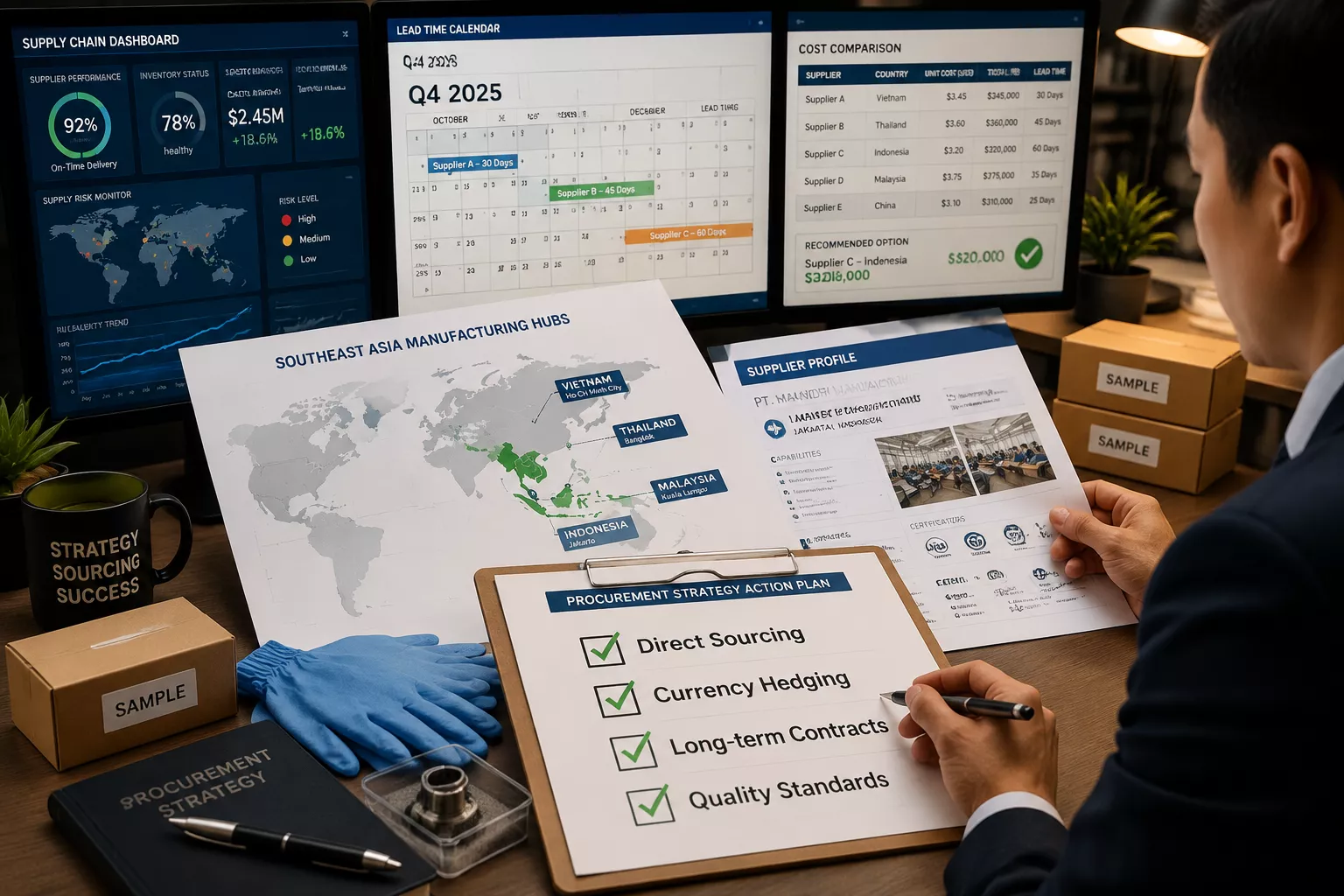
Direct Sourcing from Manufacturers 🏭
Traditional distribution channels added significant markups in the new tariff environment, creating a “tax-on-tax” effect:
Traditional Model:
- Manufacturer cost + tariff = $15
- Distributor markup (30%) = $19.50
- End buyer price = $19.50+
Direct Sourcing Model:
- Manufacturer cost + tariff = $15
- Negotiated direct pricing = $16.50
- Savings = 15-20%
Buyers who established direct relationships with Malaysian, Thai, and Vietnamese manufacturers gained:
- Better pricing control
- Priority allocation during shortages
- Customization options for glove colors and specifications
- Improved visibility into production schedules
Long-Term Contracts with Price Locks 🔒
Smart buyers negotiated 6-12 month contracts with fixed pricing to hedge against:
- Further tariff increases scheduled for 2026
- Continued NBR raw material volatility
- Currency exchange rate fluctuations
- Seasonal demand spikes
Key contract terms to negotiate:
- Volume commitments with flexibility bands (±15%)
- Quarterly price review clauses tied to documented cost indices
- Quality guarantees with third-party testing
- Force majeure provisions specific to tariff changes
Diversified Supplier Portfolio 🌍
Relying on a single country or manufacturer proved risky in Q4 2025. Leading procurement teams built diversified supplier networks:
- Primary supplier (60% of volume): Established Malaysian manufacturer
- Secondary supplier (30% of volume): Thai producer with different tariff exposure
- Tertiary supplier (10% of volume): Domestic or Mexican manufacturer for emergency needs
This approach provided resilience against country-specific tariff changes, natural disasters, or factory-specific issues.
Quality Verification Protocols ✅
As new suppliers entered the market and existing ones scaled rapidly, quality consistency became a concern. Successful buyers implemented:
- Third-party testing for ASTM D6319 (nitrile exam gloves) or EN 455 (medical gloves) compliance
- Sample testing from every production batch before full shipment acceptance
- Supplier audits focusing on manufacturing processes and quality systems
- Performance tracking of defect rates, sizing consistency, and barrier integrity
For specialized applications like food handling or electrical work, additional certification verification became essential.
Industry-Specific Considerations
Different sectors faced unique challenges within the Q4 2025 Disposable Glove Market Shifts: Tariffs, Costs, and Strategies for Nitrile Buyers.
Healthcare Sector 🏥
Hospitals and medical facilities couldn’t compromise on quality despite cost pressures:
- Maintained focus on sterile versus nonsterile specifications based on procedure requirements
- Prioritized suppliers with FDA registration and ISO 13485 certification
- Negotiated group purchasing organization (GPO) contracts to leverage volume
- Explored nitrile surgical gloves alternatives from certified Southeast Asian manufacturers
Food Service Industry 🍽️
Restaurants and food processors balanced cost with food safety compliance:
- Verified FDA food-contact compliance for all new suppliers
- Considered color-coded glove systems (blue for food prep) to maintain HACCP protocols
- Evaluated thickness requirements based on task duration and puncture risk
- Assessed whether nitrile gloves for cooking met operational needs versus cheaper alternatives
Industrial and Manufacturing 🔧
Industrial users had more flexibility to optimize cost-performance ratios:
- Specified minimum acceptable thickness (3-5 mil) rather than premium grades
- Accepted longer lead times in exchange for better pricing
- Explored recycling programs to offset disposal costs
- Considered task-specific alternatives for low-risk applications
Looking Ahead: 2026 Projections
As Q4 2025 closed, several trends pointed toward continued market evolution:
Tariff Outlook:
- Additional 50% increase on Chinese gloves scheduled for 2026
- Potential tariff adjustments on Southeast Asian imports
- Ongoing trade negotiations could shift the landscape
Supply Dynamics:
- New manufacturing capacity coming online in Mexico and Central America
- Technology investments improving production efficiency
- Consolidation among smaller manufacturers
Pricing Forecast:
- Nitrile glove prices expected to stabilize in mid-2026
- Raw material costs projected to moderate as supply increases
- Competition among non-Chinese suppliers may create pricing pressure
Strategic Imperatives:
- Maintain supplier diversification
- Monitor geopolitical developments affecting trade policy
- Invest in supplier relationship management
- Build inventory buffers for critical applications
Conclusion
The Q4 2025 Disposable Glove Market Shifts: Tariffs, Costs, and Strategies for Nitrile Buyers represent a fundamental transformation in PPE procurement. The era of cheap, readily available Chinese gloves has ended, replaced by a more complex landscape requiring strategic thinking and proactive management.
Successful nitrile buyers in 2026 and beyond will:
✅ Establish direct relationships with Southeast Asian manufacturers to control costs and secure supply
✅ Negotiate long-term contracts with price protection mechanisms to hedge against volatility
✅ Diversify supplier portfolios across multiple countries and manufacturers to mitigate risk
✅ Implement rigorous quality verification to ensure consistency as new suppliers enter the market
✅ Stay informed about tariff developments and trade policy changes that could impact costs
✅ Build strategic inventory to buffer against extended lead times and supply disruptions
The organizations that adapt quickly to this new reality—treating glove procurement as a strategic function rather than a commodity purchase—will maintain cost competitiveness and supply security. Those that continue reactive, spot-buying approaches will face ongoing price volatility and potential shortages.
Take action now: Review your current glove suppliers, assess your tariff exposure, and begin conversations with alternative manufacturers. The Q4 2025 market shifts aren’t temporary disruptions—they represent the new normal for disposable glove procurement.