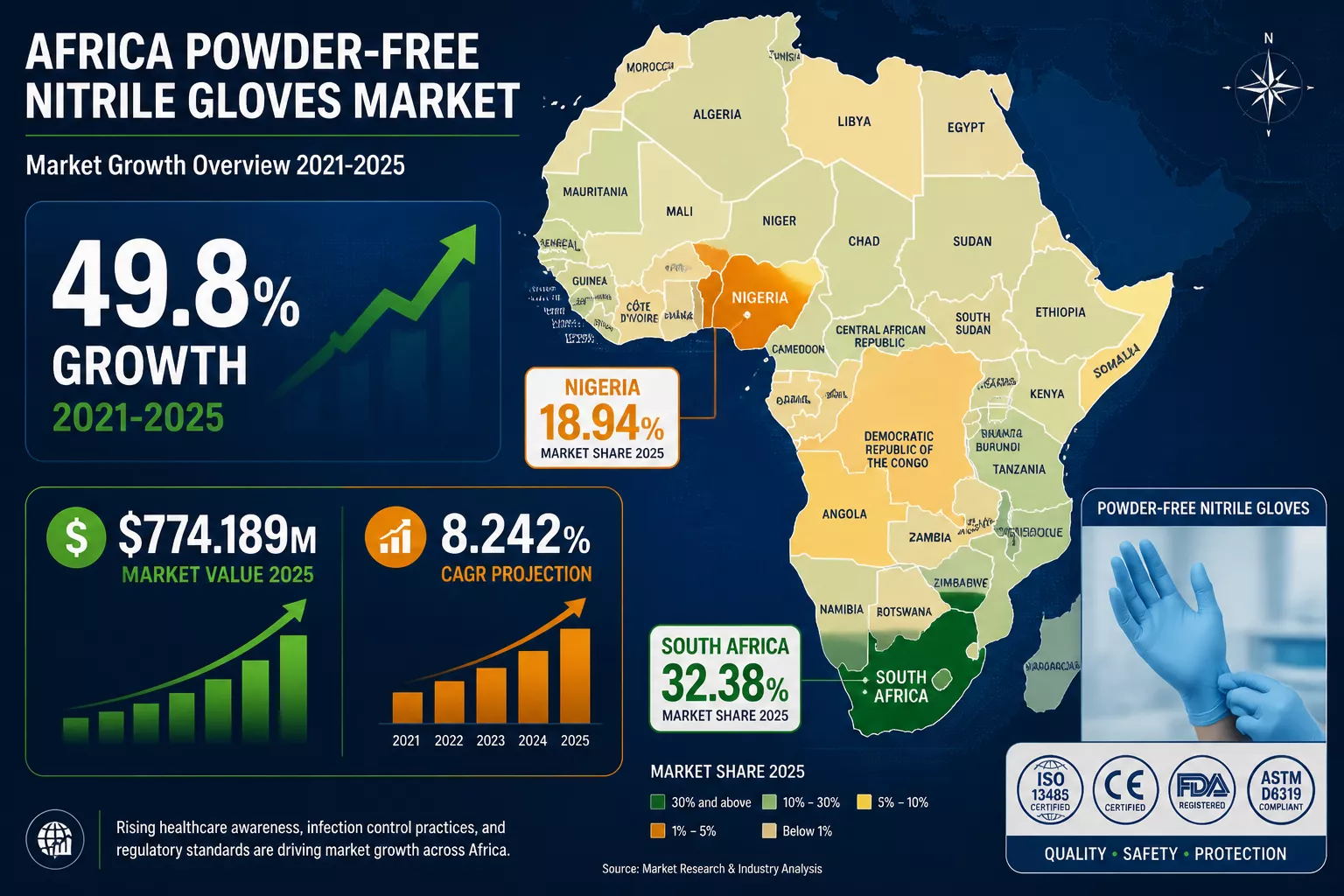
Africa’s glove market exploded by 49.8% between 2021 and 2025, transforming from a $516 million sector into a $774 million opportunity—yet this represents merely 2.62% of global market share. While Asia dominates headlines, Nitrile Gloves in Emerging Economies: Africa and Latin America Growth Opportunities and Sourcing Guide reveals untapped potential in regions where healthcare expansion and industrial modernization are creating unprecedented demand for quality protective equipment.
Understanding these non-Asian emerging markets requires navigating unique regulatory landscapes, supply chain challenges, and quality assurance protocols that differ significantly from established manufacturing hubs. For importers and distributors, the question isn’t whether to enter these markets—it’s how to do so strategically while maintaining product integrity and compliance standards.
Key Takeaways
- 🌍 Africa’s market grew 49.8% from 2021-2025, with South Africa commanding 32.38% regional share and Nigeria holding 18.94%
- 🇧🇷 Brazil leads Latin America with 31.31% market share, projected to grow at 8.1% CAGR through 2036
- ✅ Powder-free nitrile gloves dominate growth due to regulatory phase-outs in USA and EU influencing emerging market standards
- 📊 Quality assurance is critical as local regulations increasingly align with international healthcare and food safety standards
- 🔄 Supply chain diversification opportunities exist for importers seeking alternatives to Asia-Pacific manufacturing concentration
Understanding Market Dynamics in Africa and Latin America
Africa’s Rapid Expansion Trajectory
The African gloves market demonstrates remarkable momentum, projected to reach $1,458.82 million by 2033 at an 8.242% compound annual growth rate. South Africa’s dominance at 32.38% of continental market share reflects its advanced healthcare infrastructure and stringent workplace safety regulations. Nigeria follows at 18.94%, driven by expanding oil and gas industries requiring robust personal protective equipment.
The remaining 48.68% of Africa’s market opportunity spreads across diverse nations with varying regulatory maturity levels. This fragmentation creates both challenges and opportunities for distributors who can navigate multiple compliance frameworks simultaneously.
Key African Growth Drivers:
- Healthcare infrastructure investment in public and private facilities
- Mining and extractive industries requiring industrial-grade protective equipment
- Food processing sector modernization demanding food-safe gloves
- Increasing awareness of latex allergy alternatives
Latin America’s Healthcare-Driven Demand
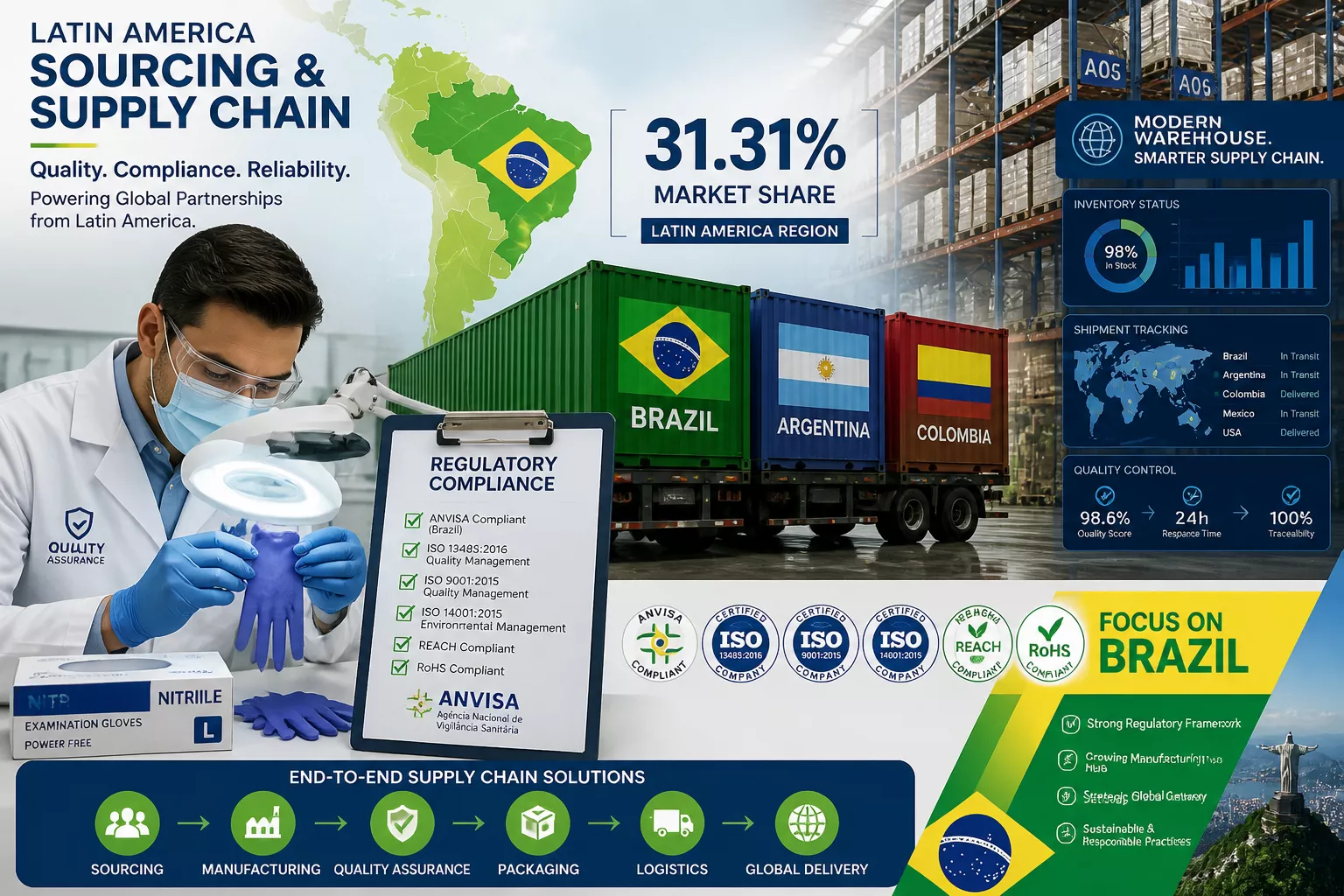
Brazil’s commanding 31.31% regional market share positions it as Latin America’s primary growth engine, with an 8.1% CAGR through 2036. Argentina (13.96%) and Colombia (8.19%) represent secondary markets with distinct regulatory requirements and distribution networks.
Latin American demand stems primarily from healthcare sector expansion and industrial safety modernization. Public health programs increasingly mandate disposable glove usage across medical facilities and food service establishments, while workplace safety regulations drive adoption in manufacturing environments.
Nitrile Gloves in Emerging Economies: Quality Assurance for Importers
Navigating Regulatory Compliance
Emerging economies increasingly adopt international standards, but implementation varies significantly by country. Importers must understand that regulatory alignment doesn’t equal enforcement consistency. Brazil’s ANVISA (National Health Surveillance Agency) maintains rigorous medical device standards comparable to FDA requirements, while other regional authorities may have less developed oversight mechanisms.
Critical Compliance Considerations:
| Region | Primary Regulatory Body | Key Standards | Enforcement Level |
|---|---|---|---|
| Brazil | ANVISA | ISO 13485, ASTM D6319 | High |
| South Africa | SAHPRA | SANS 1586, ISO standards | Medium-High |
| Nigeria | NAFDAC | SON standards | Medium |
| Argentina | ANMAT | IRAM standards | Medium |
Quality Verification Protocols
Sourcing powder-free nitrile gloves for emerging markets requires rigorous supplier vetting beyond standard certifications. The 2025 launch of accelerator-free nitrile formulations in India demonstrates innovation addressing allergic response concerns—a quality benchmark increasingly relevant for African and Latin American healthcare applications.
Essential Quality Checkpoints:
✅ Material Verification: Confirm acrylonitrile-butadiene composition meets regional chemical resistance requirements
✅ Thickness Consistency: Validate mil measurements across production batches, particularly for food handling applications
✅ Accelerator Content: Test for chemical accelerators that may trigger allergic reactions in sensitive populations
✅ Shelf Life Documentation: Verify storage conditions and expiration dating for tropical climate stability
✅ Batch Traceability: Ensure lot numbering systems enable rapid recall capabilities
Supply Chain Considerations
Emerging market distribution networks present unique logistical challenges. Port infrastructure limitations, customs clearance delays, and temperature-controlled storage requirements demand careful planning. Importers should establish multiple supply chain pathways to mitigate disruption risks.
Strategic Sourcing Approaches:
- Regional Manufacturing Partnerships: Consider local production facilities in South Africa or Brazil to reduce import dependencies
- Diversified Supplier Networks: Avoid single-source reliance by qualifying multiple manufacturers
- Climate-Appropriate Packaging: Specify moisture-resistant packaging for humid tropical environments
- Local Warehousing: Establish in-country distribution centers to improve delivery speed and reduce customs complexity
Growth Opportunities and Market Entry Strategies
Sector-Specific Opportunities
Different industries within Africa and Latin America present varying entry points for nitrile glove distributors:
Healthcare Sector 💉: Public hospital expansion programs create bulk procurement opportunities, though payment terms may extend 60-90 days. Private clinics offer faster payment but smaller order volumes.
Food Processing 🍽️: Growing middle-class populations drive food safety modernization. Understanding food-safe glove requirements positions distributors as compliance partners rather than commodity suppliers.
Industrial Manufacturing 🏭: Automotive, electronics, and chemical processing facilities require specialized nitrile formulations with enhanced chemical resistance and durability.
Agriculture 🌾: Pesticide handling and veterinary applications create demand for extended-cuff, heavy-duty nitrile gloves with superior puncture resistance.
Competitive Positioning
The global nitrile gloves market’s 15.34% CAGR (2023-2028) expansion from $6.7 billion to projected $13.67 billion creates space for specialized distributors. Rather than competing on price with Asian manufacturers, successful emerging market entrants differentiate through:
- Technical support and training for proper glove selection and usage
- Regulatory compliance assistance navigating local certification requirements
- Flexible minimum order quantities accommodating smaller regional distributors
- Value-added services including inventory management and just-in-time delivery
Sustainability Considerations
Degradable nitrile gloves represent a 15% CAGR opportunity (2025-2033), though current adoption concentrates in North America and Europe due to stricter environmental regulations. Forward-thinking distributors can position biodegradable options as premium products for environmentally conscious Latin American and African buyers, particularly in eco-tourism and organic agriculture sectors.
Conclusion
Nitrile Gloves in Emerging Economies: Africa and Latin America Growth Opportunities and Sourcing Guide reveals markets poised for sustained expansion, driven by healthcare infrastructure investment, industrial modernization, and regulatory alignment with international standards. Africa’s 49.8% growth trajectory and Brazil’s 31.31% regional dominance create compelling opportunities for distributors willing to navigate complex regulatory landscapes and supply chain challenges.
Success requires moving beyond commodity thinking to become compliance partners and technical advisors. Importers must prioritize quality assurance protocols, establish diversified supply chains, and understand sector-specific requirements across healthcare, food processing, industrial, and agricultural applications.
Actionable Next Steps:
- Conduct market-specific regulatory research for target countries, identifying certification requirements and enforcement patterns
- Qualify multiple suppliers with demonstrated quality consistency and appropriate certifications
- Establish local partnerships with distributors possessing regulatory expertise and established customer networks
- Develop technical support capabilities to differentiate from price-focused competitors
- Monitor sustainability trends to anticipate demand for biodegradable and accelerator-free formulations
The emerging economies of Africa and Latin America offer substantial growth potential for strategic importers who combine quality assurance rigor with market-specific adaptation. As these regions continue healthcare expansion and industrial modernization, nitrile glove demand will accelerate—rewarding distributors who establish strong positions now.