Food processing workers change gloves up to 40 times per shift, yet a single puncture can contaminate an entire batch. In 2026, nitrile gloves have become the undisputed champion of food safety—not just because they’re latex-free, but because they deliver 3-5 times the puncture resistance of traditional options while meeting strict FDA compliance standards. This comprehensive Nitrile Gloves for Food Processing: Puncture Resistance and Hygiene Standards Guide reveals why processors worldwide are making the switch and how to choose the right protection for your operation. 🧤
Whether you’re handling raw proteins, working with sharp tools, or managing high-volume production lines, understanding the science behind nitrile gloves for food safety can mean the difference between compliance and contamination.
Key Takeaways
- Nitrile gloves are 3-5x more puncture-resistant than latex or vinyl, reducing breakage during sharp tool handling and raw protein processing
- FDA compliance requires powder-free, food-grade nitrile meeting 21 CFR 177.2600 standards for direct food contact
- Blue nitrile gloves remain the gold standard for HACCP programs because the color enables instant visual detection of tears or contamination
- Thickness matters: 3-6 mil gloves balance dexterity with protection for most food processing tasks
- Chemical resistance to oils, acids, and cleaning solutions makes nitrile superior to vinyl for diverse food handling environments
Why Nitrile Dominates Food Processing: Beyond Basic Protection
The Puncture Resistance Advantage
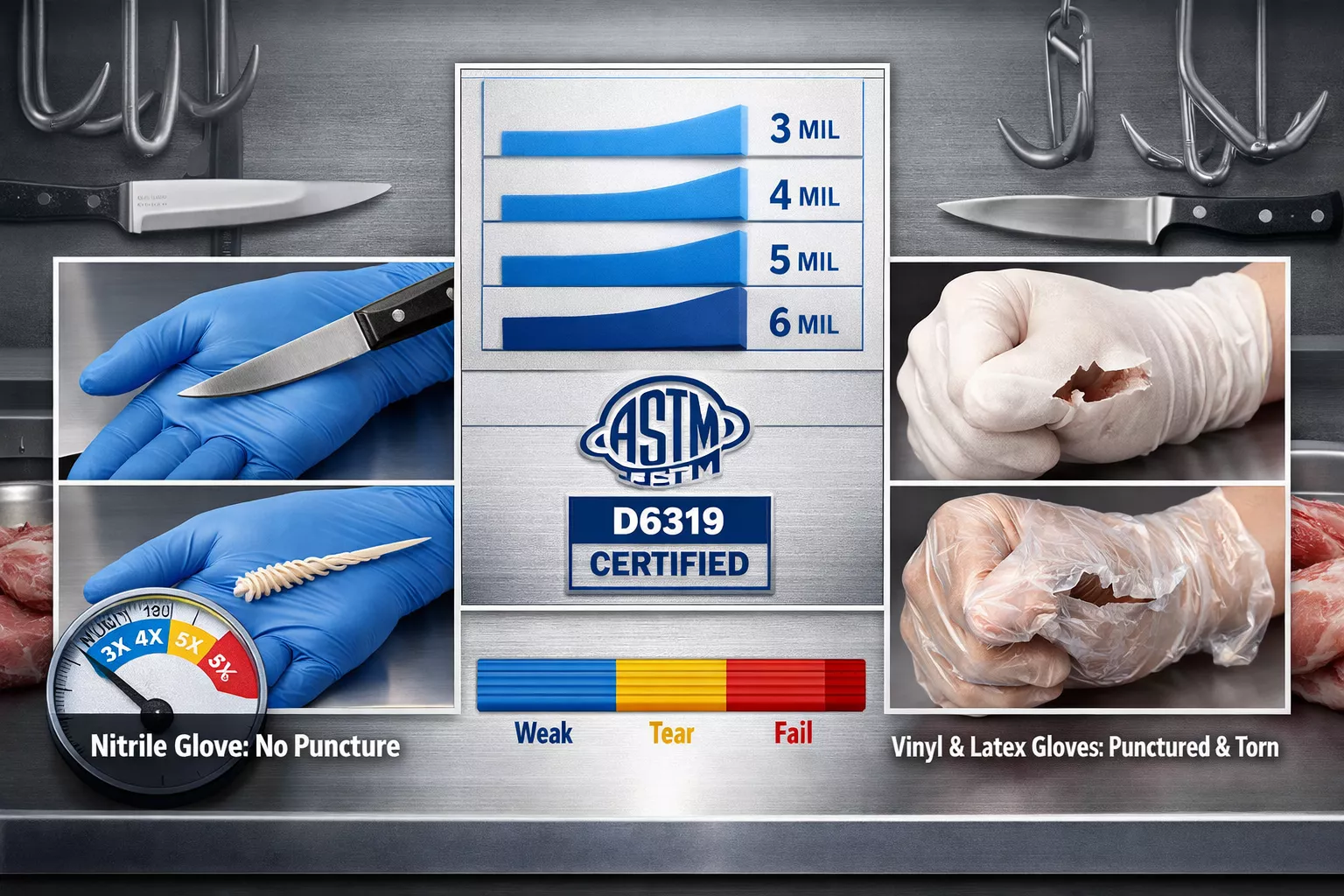
When you’re filleting fish, deboning poultry, or handling sharp packaging materials, glove failure isn’t just inconvenient—it’s a food safety crisis. Nitrile gloves deliver exceptional puncture resistance that outperforms both latex and vinyl alternatives by a significant margin.
The secret lies in the synthetic rubber composition. Unlike natural latex, nitrile’s molecular structure creates a tougher barrier that resists tears, punctures, and abrasions. Medical-grade nitrile gloves undergo even stricter FDA testing for chemical penetration and physical resilience, making them ideal for high-hygiene food environments.
Key strength factors:
- 3-5 times stronger than disposable latex gloves
- Superior resistance to sharp bones, shells, and cutting tools
- Maintains integrity when exposed to oils and fats
- Less likely to tear during extended wear periods
For processors working with raw meat, seafood, or any task involving sharp implements, this durability translates directly to reduced contamination risk and fewer glove changes. Understanding what makes a good thickness for nitrile gloves helps you match protection level to task intensity.
Chemical Barrier Performance
Food processing isn’t just about handling food—it’s about managing exposure to cleaning chemicals, sanitizers, food acids, and oils. This is where nitrile truly shines compared to vinyl alternatives.
Nitrile provides superior resistance to:
- Animal fats and vegetable oils 🥩
- Citric and acetic acids found in marinades
- Alkaline cleaning solutions
- Alcohol-based sanitizers
- Petroleum-based lubricants on equipment
This chemical resistance means gloves maintain their integrity throughout your shift, even when switching between raw protein handling and equipment cleaning. Comparing nitrile vs. vinyl gloves for food safety reveals that vinyl simply can’t match this versatility—it’s suitable only for short, low-risk tasks with minimal chemical exposure.
The Hypoallergenic Factor
Latex allergies affect approximately 1-6% of the general population and up to 17% of healthcare workers. In food processing, latex proteins can trigger reactions in both workers and consumers with sensitivities. Nitrile eliminates this risk entirely.
As a synthetic material, nitrile contains no natural rubber latex proteins. This makes it the safest choice for:
- Workers with known latex sensitivities
- Facilities serving allergen-conscious consumers
- Operations requiring strict allergen control protocols
- Environments where cross-contamination must be zero-tolerance
The hypoallergenic properties don’t compromise performance—you get latex-level dexterity without the allergy concerns.
FDA Compliance and Hygiene Standards for Food-Grade Nitrile
Understanding FDA 21 CFR 177.2600
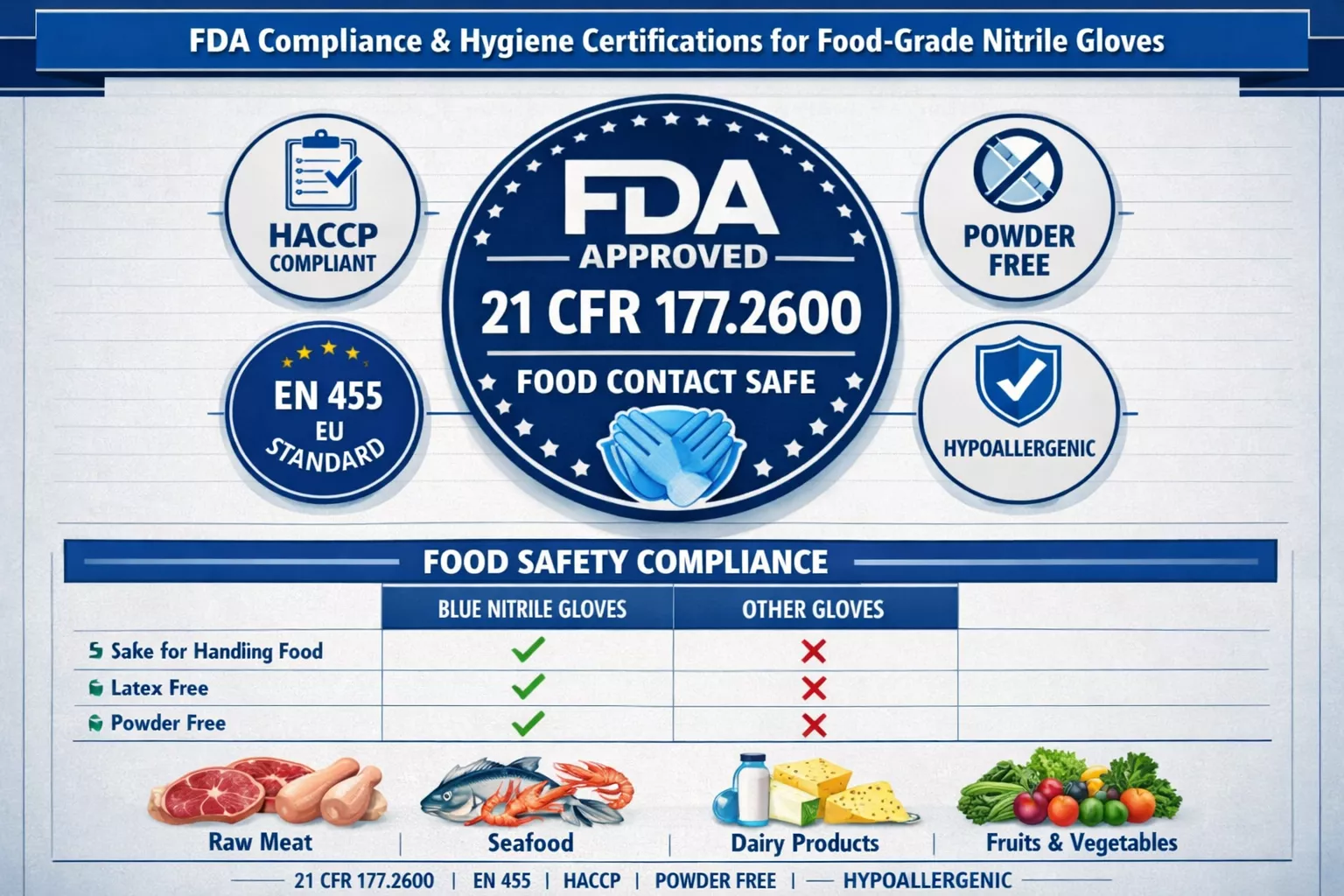
Not all nitrile gloves are created equal, and not all are food-safe. Food-grade nitrile gloves must meet specific FDA regulations outlined in 21 CFR 177.2600, which governs rubber articles intended for repeated food contact.
FDA compliance requirements include:
- Materials safe for direct food contact
- No migration of harmful substances into food
- Powder-free formulation (FDA banned powdered gloves in food service)
- Proper labeling as “food-safe” or “FDA-compliant”
When purchasing gloves for food processing, always verify FDA compliance on the packaging. Generic industrial nitrile gloves may not meet these standards and could introduce contaminants into your food products. For more details on safety standards, check out whether nitrile gloves are safe for food handling.
HACCP and Color-Coding Best Practices
Hazard Analysis and Critical Control Points (HACCP) programs worldwide recommend blue nitrile gloves as the top choice for food safety compliance in 2026. The reason is brilliantly simple: blue doesn’t occur naturally in most foods.
Benefits of blue gloves:
- ✅ Instant visual detection if glove fragments contaminate food
- ✅ Easy identification of tears or punctures during use
- ✅ Clear differentiation from food products
- ✅ Universal recognition in food safety protocols
Some facilities implement color-coding systems where different departments use different glove colors (blue for raw meat, green for produce, etc.) to prevent cross-contamination. This visual management system makes compliance monitoring easier and reduces human error.
Powder-Free Mandate
The FDA banned powdered medical gloves in 2016 due to health concerns, and this standard extends to food processing. Powder-free nitrile gloves are now the only acceptable option for food contact because:
- Powder can contaminate food products
- Cornstarch powder may harbor bacteria
- Powder interferes with proper handwashing
- Airborne particles create respiratory concerns
Modern powder-free nitrile gloves use polymer coatings or chlorination treatments to make donning easy without powder. These treatments don’t compromise food safety and actually improve glove performance.
Additional Certification Standards
Beyond FDA compliance, look for these certifications when selecting nitrile gloves for food processing:
| Standard | What It Covers | Why It Matters |
|---|---|---|
| ASTM D6319 | Nitrile examination gloves | Ensures minimum performance specifications |
| EN455 | European medical glove standards | International quality benchmark |
| ISO 374 | Chemical resistance testing | Validates barrier protection claims |
| NSF/ANSI 2 | Food equipment materials | Confirms food-contact safety |
These certifications provide third-party verification that gloves meet rigorous safety and performance standards.
Selecting the Right Nitrile Gloves for Your Food Processing Operation
Thickness and Mil Ratings Explained
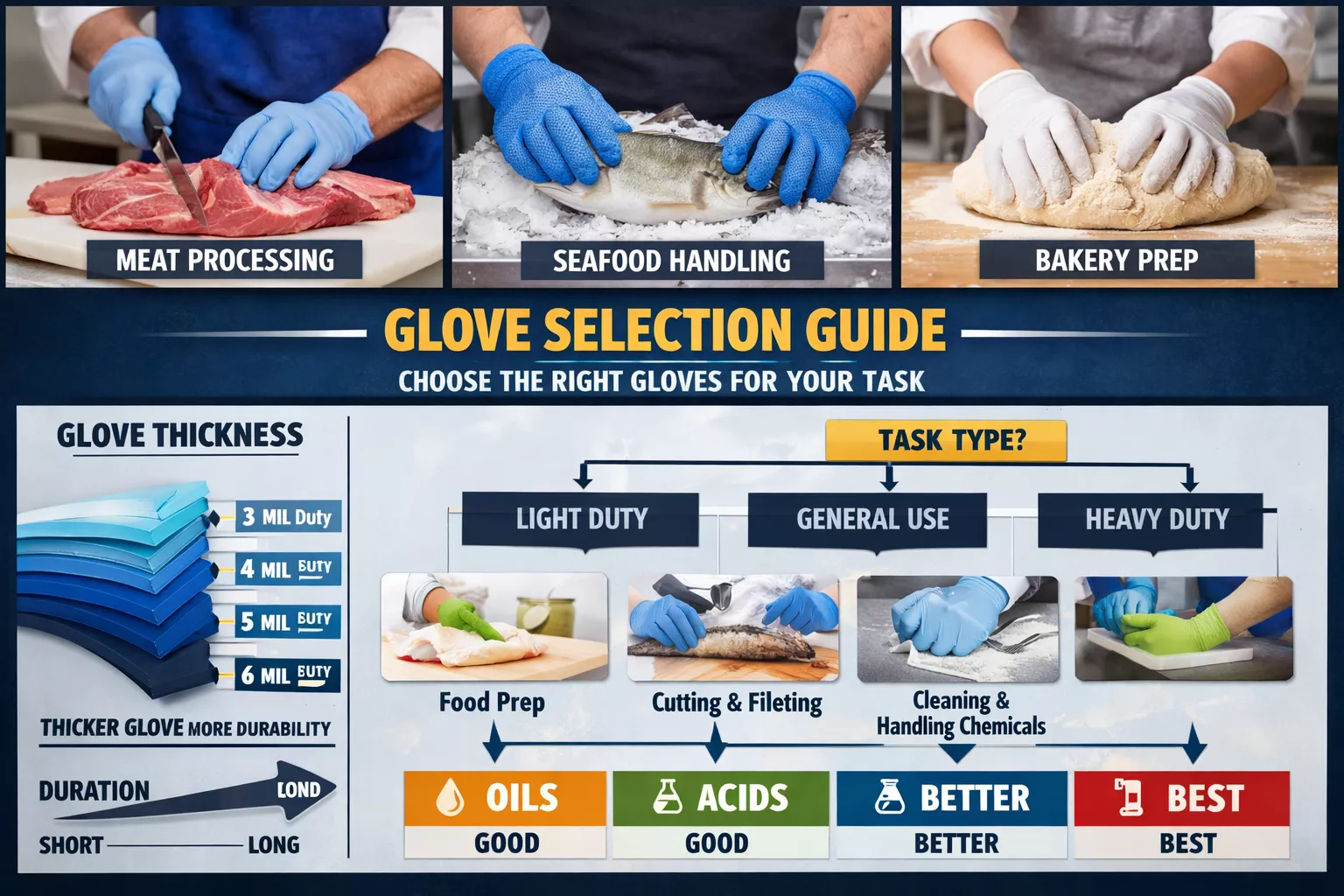
Glove thickness is measured in mils (one mil = 0.001 inch). For food processing, the sweet spot is typically 3-6 mil, which balances protection with tactile sensitivity.
Thickness recommendations by task:
- 3-4 mil: Light food prep, produce handling, bakery work, short-duration tasks
- 4-5 mil: General food processing, meat cutting, seafood handling, moderate chemical exposure
- 6-8 mil: Heavy-duty processing, extended wear, maximum puncture protection, industrial cleaning
Thicker isn’t always better—gloves above 6 mil can reduce dexterity and make detailed work difficult. Understanding thin vs. thick nitrile gloves helps you match protection to task requirements without sacrificing hand function.
Textured vs. Smooth Grip
Food processing often involves wet, slippery conditions. Textured nitrile gloves feature raised patterns on fingertips and palms that dramatically improve grip.
When to choose textured gloves:
- Handling wet or oily foods 🐟
- Working with slippery packaging materials
- Operating equipment with smooth controls
- Any task requiring precision grip in wet conditions
Smooth gloves work fine for dry food handling and situations where maximum tactile sensitivity is needed, but textured options provide better control in most food processing scenarios.
Sizing for Comfort and Safety
Proper fit is critical for both safety and efficiency. Gloves that are too tight cause hand fatigue and tear easily. Gloves that are too loose reduce dexterity and can catch on equipment.
Sizing tips:
- Measure hand circumference at the widest part (excluding thumb)
- Allow slight stretch without excessive tightness
- Fingers should reach glove fingertips without bunching
- Cuff should extend at least 1 inch past wrist
Most manufacturers offer sizes from XS to XXL, with some providing extended sizes for better fit across diverse workforces.
Medical-Grade vs. Industrial-Grade
While both types can be food-safe, medical-grade nitrile gloves offer advantages for high-hygiene food processing:
Medical-grade benefits:
- Stricter quality control and testing
- Lower defect rates (typically under 1.5 AQL)
- Enhanced barrier protection
- More consistent thickness throughout glove
Industrial-grade gloves may be suitable for lower-risk tasks but medical-grade provides the highest assurance for critical food safety applications.
Cost vs. Value Considerations
Premium nitrile gloves cost more upfront but deliver better value through:
- Fewer glove changes due to superior durability
- Reduced contamination incidents and associated costs
- Lower injury rates from punctures and tears
- Better worker comfort leading to improved productivity
Calculate cost per hour of protection rather than cost per glove to understand true value. A glove that lasts twice as long at 50% higher cost actually saves money.
Best Practices for Using Nitrile Gloves in Food Processing
Proper Donning and Doffing Techniques
Even the best gloves fail if used incorrectly. Follow these steps for maximum protection:
Donning:
- Wash and dry hands thoroughly
- Check gloves for visible defects before use
- Avoid touching glove exterior with bare hands
- Ensure cuff extends past wrist
Doffing:
- Grasp outside of one glove near wrist
- Peel away from body, turning inside-out
- Hold removed glove in gloved hand
- Slide fingers under remaining glove at wrist
- Peel off, creating a bundle with first glove inside
- Dispose properly and wash hands immediately
When to Change Gloves
Change gloves immediately when:
- ⚠️ Switching between raw and ready-to-eat foods
- ⚠️ Touching non-food surfaces (phones, doors, hair)
- ⚠️ Gloves become torn, punctured, or visibly soiled
- ⚠️ After handling allergens
- ⚠️ Every 2-4 hours during continuous use
Remember: gloves are not a substitute for handwashing. Wash hands before donning gloves and after removing them.
Storage and Handling
Proper storage extends glove life and maintains safety:
- Store in cool, dry location away from direct sunlight
- Keep boxes sealed until use to prevent contamination
- Use first-in, first-out rotation to prevent aging
- Avoid storage near chemicals or strong odors
- Maintain temperature between 50-80°F
Training Your Team
The best gloves only work when staff use them correctly. Implement comprehensive training covering:
- Food safety regulations and why they matter
- Proper glove selection for different tasks
- Correct donning, doffing, and disposal procedures
- When to change gloves during shifts
- How to identify compromised gloves
Regular refresher training and visual reminders help maintain compliance and protect both workers and consumers.
Common Mistakes to Avoid
Even experienced food processors sometimes make these errors:
❌ Using the same gloves for multiple tasks without changing between raw and cooked foods ❌ Washing and reusing disposable gloves (this compromises barrier protection) ❌ Choosing vinyl to save money for tasks requiring puncture resistance ❌ Ignoring visible tears because the glove “still mostly works” ❌ Skipping handwashing because “I’m wearing gloves anyway” ❌ Buying non-food-grade nitrile to cut costs
These shortcuts create serious food safety risks that far outweigh any perceived savings or convenience.
The Future of Food Processing Gloves in 2026 and Beyond
The food safety industry continues evolving, with several trends shaping glove technology:
Emerging innovations:
- Antimicrobial coatings that inhibit bacterial growth
- Biodegradable nitrile formulations reducing environmental impact
- Smart gloves with embedded sensors detecting contamination
- Enhanced grip technologies for improved wet handling
- Sustainable manufacturing processes
As regulations tighten and consumer expectations rise, investing in quality nitrile gloves becomes increasingly important for maintaining competitive advantage and regulatory compliance.
Conclusion
The Nitrile Gloves for Food Processing: Puncture Resistance and Hygiene Standards Guide demonstrates why nitrile has become the industry standard for food safety in 2026. With 3-5 times the puncture resistance of alternatives, superior chemical barrier protection, and hypoallergenic properties, nitrile gloves deliver unmatched performance for food processors.
Success requires more than just buying FDA-compliant gloves—it demands understanding thickness requirements, implementing proper usage protocols, and training staff on best practices. Blue, powder-free, food-grade nitrile gloves in the 3-6 mil range provide optimal protection for most food processing applications.
Take action today:
- Audit your current glove inventory for FDA compliance
- Calculate true cost-per-hour protection for different glove options
- Implement color-coding systems aligned with HACCP principles
- Train staff on proper donning, doffing, and change protocols
- Establish relationships with reliable suppliers offering certified food-grade nitrile
By prioritizing quality nitrile gloves and proper usage protocols, you protect your workers, your consumers, and your business reputation. The investment in premium food-grade nitrile gloves pays dividends through reduced contamination incidents, improved worker safety, and seamless regulatory compliance.
For more guidance on selecting the right gloves for your specific needs, explore our resources on choosing nitrile gloves for cooking and understanding nitrile glove composition.