Last updated: April 16, 2026
Quick Answer
Disposable nitrile gloves in automotive settings must meet specific ASTM standards (D6978, F739, D6319) for chemical permeation resistance against brake fluid, solvents, and oils. Glove thickness between 6-8 mils provides optimal protection against chemical degradation and mechanical stress, while advanced testing methods like electrical conductivity testing can detect sub-micron defects that visual inspection misses. For multi-hazard scenarios, layered glove systems or specialized automotive-grade nitrile formulations balance protection with the dexterity needed for precision work.
Key Takeaways
- ASTM D6978 and ASTM F739 are critical standards for evaluating nitrile glove resistance to automotive chemicals and breakthrough times
- Glove thickness directly affects chemical permeation rates—thinner gloves (4 mil) degrade 3-4 times faster than 8 mil gloves when exposed to brake fluid
- Flexural fatigue from repetitive wrenching creates micro-perforations after approximately 500-800 flex cycles in standard 6 mil gloves
- Electrical conductivity testing and pressure decay methods detect pinholes smaller than 10 microns that escape visual inspection
- Double-gloving with a thin inner nitrile layer (4 mil) and thicker outer layer (8 mil) provides superior protection in multi-hazard environments
- Material degradation accelerates dermal absorption risk exponentially—compromised gloves can increase chemical penetration by 200-400%
- Regular glove changes every 30-60 minutes during continuous chemical exposure significantly reduce contamination risk
What ASTM Standards Matter Most for Disposable Nitrile Gloves in Automotive Work?
Three ASTM standards form the foundation for selecting appropriate disposable nitrile gloves in automotive environments: ASTM D6978 (standard practice for assessing the chemical resistance of protective gloves), ASTM F739 (test method for permeation of liquids and gases through protective clothing materials), and ASTM D6319 (standard specification for nitrile examination gloves).
ASTM D6978 provides a classification system that rates glove performance against specific chemicals. For automotive workers, this standard helps identify gloves that resist common workshop fluids including gasoline, diesel fuel, transmission fluid, and coolants. The standard uses a numerical rating system where higher scores indicate better resistance.
ASTM F739 measures breakthrough time—the elapsed time between initial chemical contact and detection on the glove’s inner surface. For automotive applications, look for these minimum breakthrough times:
- Brake fluid (DOT 3/4): Minimum 30 minutes for light tasks, 60+ minutes for extended exposure
- Gasoline and diesel: 60+ minutes
- Motor oil: 120+ minutes
- Acetone and MEK (common solvents): 10-30 minutes depending on concentration
ASTM D6319 establishes quality requirements for nitrile examination gloves, including acceptable quality levels (AQL) for pinholes. An AQL of 1.5 or lower indicates higher manufacturing quality—critical when working with hazardous automotive chemicals.
Common mistake: Many shops purchase gloves based solely on thickness without verifying ASTM compliance. A thick glove without proper chemical resistance certification may fail faster than a thinner, properly rated glove.
For detailed guidance on selecting gloves for specific automotive tasks, see our guide to the best mechanic nitrile gloves.
How Do Thickness and Degradation Rate Affect Chemical Absorption Risk?
Glove thickness and material degradation work together to determine how quickly harmful chemicals reach your skin. Thicker gloves provide more material for chemicals to penetrate, but degradation from chemical attack reduces this protective barrier over time.
Standard disposable nitrile gloves range from 4 to 8 mils in thickness. When exposed to brake fluid (glycol-based), degradation rates vary significantly:
| Glove Thickness | Initial Breakthrough Time | Degradation Rate | Effective Protection Window |
|---|---|---|---|
| 4 mil | 15-20 minutes | High (swelling visible in 10 min) | 10-15 minutes |
| 6 mil | 30-40 minutes | Moderate (swelling in 20 min) | 25-30 minutes |
| 8 mil | 60-90 minutes | Low (swelling in 40 min) | 50-70 minutes |
The synergistic risk: As brake fluid penetrates nitrile, it causes polymer chain swelling and softening. This degradation accelerates permeation exponentially. A glove that initially blocks 99% of chemical contact may drop to 60% effectiveness within 15 minutes of continuous exposure, then to 20% effectiveness within 30 minutes.
Dermal absorption risk increases dramatically once degradation begins. Compromised glove material acts like a saturated sponge—it no longer blocks chemicals but instead holds them against your skin, increasing contact time and absorption.
Protection strategy: Change gloves every 30 minutes when working with aggressive solvents or brake fluid, even if the gloves appear intact. For tasks requiring extended chemical contact, choose 8 mil gloves and implement a scheduled change protocol.
Learn more about how nitrile glove thickness impacts durability and protection.
What Are the Flexural Fatigue Limits for Disposable Nitrile Gloves in Automotive Tasks?
Flexural fatigue occurs when repeated bending and flexing causes microscopic cracks in nitrile material. In automotive work—particularly during high-torque wrenching, socket work, and repetitive gripping—this mechanical stress creates failure points that compromise chemical protection.
Standard 6 mil nitrile gloves typically withstand 500-800 complete flex cycles before micro-perforation formation becomes statistically significant. A flex cycle represents one complete bend-and-release motion, such as gripping and releasing a wrench handle.
Quantifiable thresholds:
- Light-duty tasks (oil changes, fluid checks): Gloves remain effective for 2-3 hours of continuous use
- Medium-duty tasks (brake work, suspension repair): Glove integrity compromises after 1-2 hours
- Heavy-duty tasks (engine removal, transmission work): Micro-perforations likely after 30-60 minutes
High-torque scenarios accelerate failure. When applying significant force to a wrench or breaker bar, stress concentrates at the finger joints and palm creases. These areas experience 3-5 times more flexural stress than other glove regions.
Micro-perforation formation correlation: Research indicates that once a glove reaches 60-70% of its flexural fatigue limit, micro-perforations begin forming at stress concentration points. These defects measure 1-50 microns—too small for visual detection but large enough to allow chemical penetration.
Practical application: For repetitive high-torque work, implement a glove change schedule based on task intensity rather than time alone. If you’re performing 100+ wrench operations per hour, change gloves every 45-60 minutes regardless of visible wear.
Consider thicker nitrile gloves for tasks involving sustained mechanical stress combined with chemical exposure.
What Advanced Testing Methods Detect Sub-Micron Defects in Used Disposable Nitrile Gloves?
Visual inspection catches obvious tears and punctures but misses the sub-micron pinholes that develop during automotive work. Several non-destructive testing methods provide reliable detection in high-contamination environments.
Electrical conductivity testing uses a conductive solution inside the glove and an electrode array outside. When current flows between electrodes, it indicates a breach. This method detects holes as small as 10 microns and works even when gloves are contaminated with oils and fluids. The test takes 15-30 seconds per glove.
Pressure decay testing inflates the glove to a specific pressure (typically 1-2 PSI) and monitors pressure loss over 30-60 seconds. A pressure drop exceeding 10% indicates perforation. This method identifies defects down to 5 microns but requires clean, dry gloves for accurate results.
Water leak testing (modified from ASTM D5151) involves filling the glove with water and observing for leaks. While simple, this method only detects holes larger than 50 microns and creates disposal challenges in automotive shops.
Fluorescent dye penetration testing applies a fluorescent tracer to the glove exterior, then inspects the interior under UV light after a dwell time. This method reveals penetration pathways through micro-perforations and degraded material zones. It’s particularly useful for evaluating chemical degradation patterns.
Best practice for automotive shops: Implement electrical conductivity testing for gloves used in critical chemical handling tasks (brake fluid, battery acid, strong solvents). The equipment costs $200-500 but provides objective quality control that protects workers from invisible contamination.
Edge case: Gloves contaminated with metallic particles or conductive fluids may produce false positives in electrical testing. Clean gloves with isopropyl alcohol and dry thoroughly before testing.
For more information on glove protection capabilities, see what nitrile gloves protect against.
How Should You Layer Gloves for Multi-Hazard Automotive Scenarios?
Multi-hazard scenarios—such as brake system work involving chemical splash followed by abrasive contact with corroded parts—require strategic glove layering that maintains both protection and dexterity.
The optimal layering strategy uses a thin inner nitrile glove (4 mil) combined with a thicker outer nitrile glove (8 mil). This configuration provides several advantages:
Protection benefits:
- The inner layer acts as a backup barrier if the outer glove fails
- Chemical breakthrough must penetrate two distinct barriers, doubling effective protection time
- If the outer glove tears, the inner layer provides continued protection while you change gloves
- The air gap between layers reduces heat transfer from chemical reactions
Dexterity considerations:
- Total thickness of 12 mils (combined) still allows adequate tactile feedback for most automotive tasks
- The inner glove’s smooth surface allows the outer glove to slide easily, reducing binding during hand movements
- Finger dexterity remains sufficient for socket selection, bolt manipulation, and connector work
Efficacy validation methods:
Permeation testing: Test the layered system against target chemicals using ASTM F739 protocols. Properly layered gloves should show breakthrough times 2-3 times longer than single-layer equivalents.
Mechanical stress testing: Subject layered gloves to flexural fatigue testing. The system should withstand 1,200-1,500 flex cycles before failure—approximately double the single-glove threshold.
Dexterity assessment: Use standardized tests like the Purdue Pegboard Test to measure fine motor performance. Acceptable layered systems should maintain at least 80% of bare-hand dexterity scores.
Field validation: Monitor actual failure rates and chemical exposure incidents. A successful layering strategy should reduce chemical contact events by 60-80% compared to single-glove use.
Alternative approach: For maximum protection in extreme multi-hazard scenarios, use a thin nitrile inner glove with a specialized chemical-resistant outer glove (such as butyl rubber for specific solvents). This sacrifices some dexterity but provides superior protection against aggressive chemicals.
Choose layering if: You’re working with highly corrosive chemicals (battery acid, strong degreasers) combined with sharp edges or abrasive surfaces. Choose single heavy-duty gloves if dexterity is paramount and chemical exposure is moderate.
Understanding how nitrile gloves fare against abrasion helps inform layering decisions for mechanically demanding tasks.
When Should You Replace Disposable Nitrile Gloves During Automotive Work?
Knowing when to change gloves prevents chemical exposure and maintains protection effectiveness. Disposable nitrile gloves in automotive settings require replacement based on time, exposure, and visible condition—not just obvious damage.
Time-based replacement guidelines:
- Continuous chemical exposure: Every 30-60 minutes regardless of visible wear
- Intermittent chemical contact: Every 2-3 hours or after 10-15 exposure incidents
- Mechanical work with minimal chemicals: Every 3-4 hours or when dexterity decreases
- Heavy contamination environments: Every 1-2 hours minimum
Exposure-based triggers for immediate replacement:
- Contact with strong acids or bases (battery acid, heavy-duty cleaners)
- Immersion in solvents for more than 30 seconds
- Exposure to brake fluid exceeding 15 minutes cumulative time
- Contact with gasoline or diesel for more than 45 minutes
- Any exposure to carcinogenic substances (asbestos, certain oils)
Visible condition indicators:
- Swelling or softening: Material degradation has begun—replace immediately
- Discoloration: Chemical absorption has occurred—protection is compromised
- Stiffness or brittleness: Material has degraded—micro-perforations likely present
- Tackiness or stickiness: Chemical reaction with glove material—barrier function lost
- Loss of elasticity: Polymer chains damaged—mechanical protection reduced
The 30-minute rule: For tasks involving continuous contact with aggressive automotive chemicals (brake fluid, carburetor cleaner, transmission fluid), implement a mandatory 30-minute change interval. This prevents the exponential increase in permeation that occurs as material degrades.
Cost vs. safety calculation: A box of 100 quality nitrile gloves costs $15-25. Changing gloves every 30 minutes during a 4-hour brake job uses 8 pairs ($1.20-2.00). Compare this to the medical costs and lost work time from chemical dermatitis or systemic absorption—easily thousands of dollars.
Shop protocol recommendation: Establish visible timers or reminders in work areas. When starting a chemical-intensive task, set a timer for 30 minutes as a glove change reminder.
What Specific Automotive Chemicals Degrade Disposable Nitrile Gloves Fastest?
Not all automotive fluids attack nitrile equally. Understanding which chemicals pose the greatest degradation risk helps you select appropriate gloves and implement proper change intervals.
Fastest degrading chemicals (high risk):
Ketones (acetone, MEK): Breakthrough time of 5-15 minutes in standard nitrile. These solvents cause rapid swelling and softening. Used in paint thinners, adhesive removers, and some cleaners.
Aromatic hydrocarbons (toluene, xylene): Breakthrough in 10-20 minutes. Found in some degreasers and specialty cleaners. Cause significant polymer degradation.
Chlorinated solvents (brake cleaner, carburetor cleaner): Breakthrough in 15-30 minutes. Extremely aggressive against nitrile. Cause brittleness and cracking.
Moderate degradation chemicals (medium risk):
Brake fluid (glycol-based): Breakthrough in 30-60 minutes depending on thickness. Causes swelling and softening. Continuous exposure significantly accelerates degradation.
Gasoline and diesel: Breakthrough in 45-90 minutes. Cause gradual softening but less aggressive than solvents. Extended exposure reduces barrier effectiveness.
Transmission fluid: Breakthrough in 60-120 minutes. Moderate degradation risk with prolonged contact.
Lower risk chemicals:
Motor oil: Breakthrough exceeds 120 minutes in quality nitrile. Minimal degradation with typical exposure times.
Coolant (ethylene glycol): Good resistance with breakthrough times exceeding 180 minutes.
Water-based cleaners: Excellent resistance. Minimal degradation concern.
Critical distinction: Breakthrough time measures when chemicals first penetrate to the inner surface. Visible degradation often occurs earlier, signaling that barrier effectiveness is declining rapidly.
Practical application: When working with high-risk chemicals, use thicker gloves (8 mil minimum) and change them every 15-20 minutes. For medium-risk chemicals, 6 mil gloves with 30-minute changes provide adequate protection. Low-risk chemicals allow longer wear times but still require changes every 2-3 hours.
For specific guidance on oil resistance, see our article on nitrile gloves and oil protection.
How Do Temperature Extremes Affect Disposable Nitrile Gloves in Automotive Settings?
Automotive work exposes gloves to temperature extremes—from cold winter mornings to hot engine compartments. Temperature significantly impacts nitrile performance, flexibility, and chemical resistance.
Cold temperature effects (below 40°F/4°C):
Nitrile becomes stiffer and less flexible in cold conditions. This reduces dexterity and increases the risk of tears during donning. Chemical resistance actually improves slightly at lower temperatures because molecular movement slows, reducing permeation rates.
Practical cold-weather strategies:
- Warm gloves to room temperature before use
- Choose thinner gloves (4-6 mil) for better flexibility in cold
- Allow extra time for precise tasks as dexterity decreases
- Store gloves in heated areas, not in unheated toolboxes
Hot temperature effects (above 90°F/32°C):
Heat accelerates chemical permeation significantly. At 100°F, breakthrough times can decrease by 30-50% compared to room temperature. Heat also increases hand perspiration, which can cause gloves to slip and reduce grip.
High-temperature considerations:
- Reduce glove change intervals by 25-30% when working in hot conditions
- Use powder-free gloves to prevent powder from becoming sticky with sweat
- Consider gloves with textured grips for better control
- Take breaks to cool hands and reduce perspiration buildup
Extreme heat exposure (engine components, exhaust systems):
Standard nitrile gloves provide no protection against thermal burns. When touching hot components, use heat-resistant gloves rated for the specific temperature. Never rely on disposable nitrile gloves for thermal protection—they will melt and cause severe burns.
Temperature cycling effects:
Repeated heating and cooling (common when moving between cold outdoor work and warm engine compartments) accelerates material fatigue. This cycling causes micro-cracking that compromises chemical resistance.
For more details on cold temperature effects, see our guide on cold temperature and nitrile gloves.
What Role Does Glove Color Play in Automotive Safety?
Glove color serves practical safety functions beyond aesthetics in automotive environments. Different colors help workers quickly identify contamination, select appropriate gloves for specific tasks, and maintain quality control.
Black nitrile gloves: Most popular in automotive settings because they hide oil and grease stains, maintaining a cleaner appearance. However, this same property makes it difficult to spot chemical contamination or degradation. Best for general mechanical work with minimal chemical exposure.
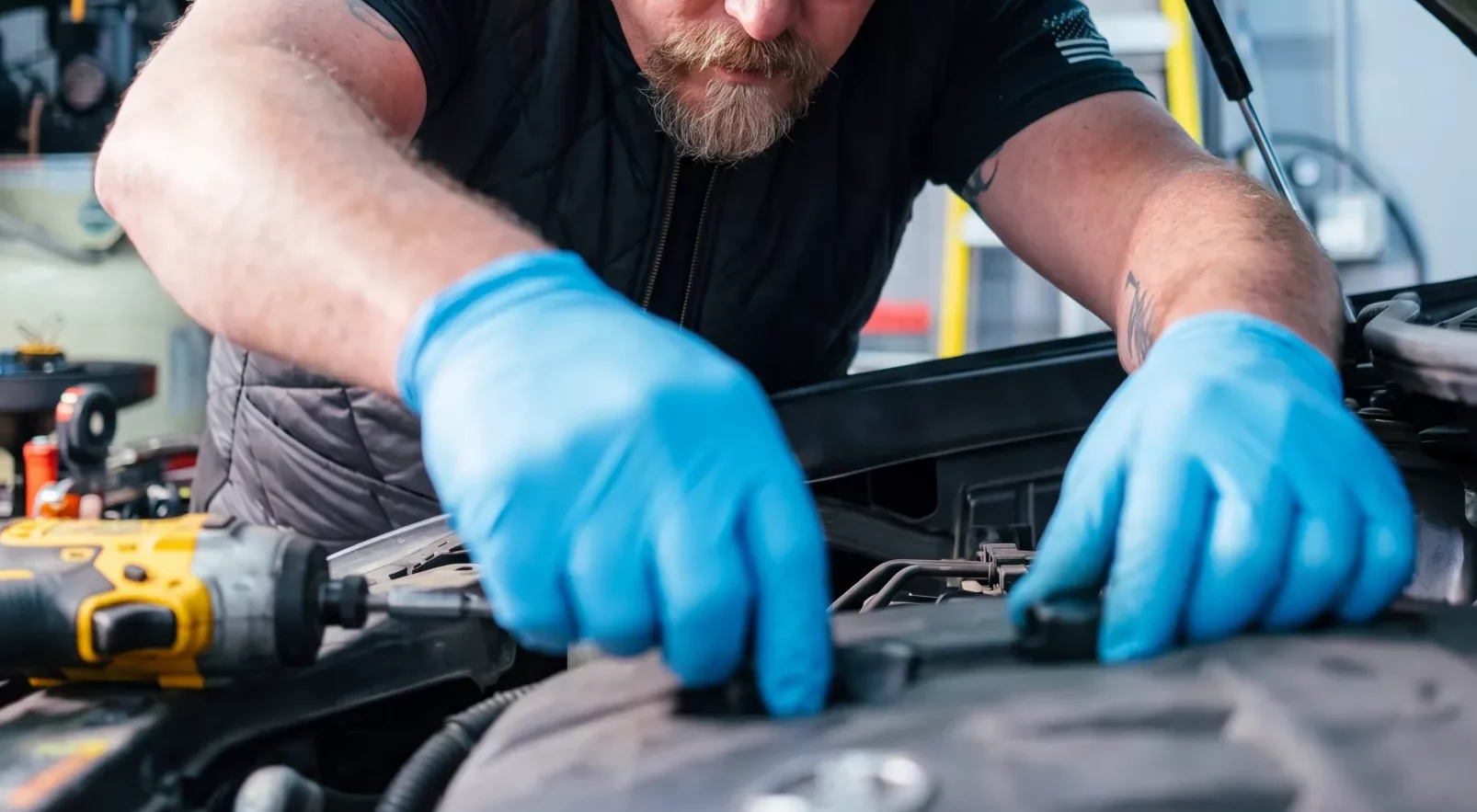
Blue nitrile gloves: Provide excellent contamination visibility. Chemical stains, oils, and degradation show clearly against the blue background. Recommended for tasks involving brake fluid, solvents, or other chemicals where visual monitoring of glove condition is important.
Orange nitrile gloves: High visibility color helps supervisors quickly identify workers handling chemicals. Often used in shops with color-coded safety protocols. The bright color makes contamination obvious.
Purple or green nitrile gloves: Sometimes used to designate specific task areas (paint booth, detail work) or to differentiate between glove thicknesses. Helps prevent cross-contamination between work zones.
Safety protocol recommendation: Use blue or orange gloves for chemical-intensive tasks where monitoring glove condition is critical. Use black gloves for general mechanical work where appearance matters but chemical exposure is minimal.
Color-coding system example:
- Blue = Chemical handling (brake fluid, solvents, cleaners)
- Black = General mechanical work (oil changes, tire work)
- Orange = Battery service and acid handling
- Green = Paint and body work
This system helps workers grab appropriate gloves quickly and allows supervisors to verify proper glove selection at a glance.
Learn more about nitrile glove colors and their applications.
How Can Automotive Shops Implement Effective Glove Safety Programs?
A comprehensive glove safety program reduces chemical exposure incidents, improves compliance, and protects workers from long-term health effects. Implementation requires clear protocols, training, and monitoring.
Program components:
1. Hazard assessment: Document all chemicals used in the shop and their associated risks. Match each chemical to appropriate glove specifications (thickness, material, change interval).
2. Glove selection matrix: Create a simple chart showing which glove type to use for each task:
- Oil changes: 4-6 mil black nitrile
- Brake work: 6-8 mil blue nitrile, 30-minute changes
- Solvent cleaning: 8 mil nitrile, 15-minute changes
- Battery service: 8 mil nitrile with extended cuffs
3. Training protocol: Train all technicians on:
- Proper donning and doffing techniques
- Recognition of degradation signs
- Change interval requirements
- Disposal procedures for contaminated gloves
4. Accessibility: Place glove dispensers at every workstation. Workers are more likely to change gloves frequently when fresh gloves are immediately available.
5. Monitoring and compliance: Implement spot checks to verify proper glove use. Track glove consumption rates—low usage may indicate non-compliance.
6. Incident reporting: Establish a system for reporting chemical contact incidents, even minor ones. Use this data to refine glove selection and change intervals.
Cost management: Bulk purchasing reduces glove costs significantly. A shop using 500 pairs monthly can reduce per-glove costs by 30-40% through bulk orders.
Compliance motivation: Frame glove changes as a professional standard, not just a safety requirement. Emphasize that proper glove use prevents chronic conditions like dermatitis that can end careers.
Documentation: Maintain records of glove specifications, training dates, and incident reports. This documentation demonstrates due diligence and supports workers’ compensation claims if exposure incidents occur.
FAQ
How long can you safely wear nitrile gloves when working with brake fluid? Maximum 30 minutes for 6 mil gloves, 60 minutes for 8 mil gloves. Change immediately if swelling or softening occurs. Continuous exposure requires more frequent changes than intermittent contact.
Do thicker nitrile gloves always provide better chemical protection? Generally yes, but thickness alone doesn’t guarantee protection. A thick glove without proper chemical resistance formulation may fail faster than a thinner, chemically-resistant glove. Always verify ASTM compliance for your specific chemicals.
Can you reuse disposable nitrile gloves in automotive work? No. Once exposed to chemicals or contaminated with oils and fluids, disposable gloves should be discarded. Reuse increases contamination risk and compromises barrier effectiveness.
What’s the difference between automotive-grade and medical-grade nitrile gloves? Automotive-grade gloves typically offer thicker material (6-8 mil vs. 3-5 mil), better chemical resistance, and textured grips. Medical-grade gloves prioritize tactile sensitivity and sterility over chemical resistance.
How do you know if a nitrile glove has been compromised by chemicals? Look for swelling, softening, discoloration, stiffness, tackiness, or loss of elasticity. Any of these signs indicate chemical degradation and require immediate glove replacement.
Are powder-free nitrile gloves better for automotive work? Yes. Powder-free gloves prevent powder from mixing with oils and chemicals, which can create sticky residues. They also reduce contamination of parts and surfaces.
Can nitrile gloves protect against all automotive chemicals? No. Nitrile offers excellent resistance to oils, fuels, and many solvents, but some chemicals (strong ketones, certain chlorinated solvents) degrade nitrile rapidly. Always check compatibility for specific chemicals.
What should you do if chemicals contact your skin despite wearing gloves? Remove gloves immediately, wash the affected area thoroughly with soap and water for at least 15 minutes, and seek medical attention if irritation develops. Report the incident to your supervisor.
How should contaminated nitrile gloves be disposed of? Place in designated chemical waste containers if heavily contaminated with hazardous materials. Lightly soiled gloves can typically go in regular trash, but check local regulations and shop policies.
Do nitrile gloves provide protection against cuts and punctures? Limited protection. Nitrile resists small punctures better than latex but won’t stop sharp metal edges, wire, or significant cutting forces. Use cut-resistant gloves over nitrile for tasks involving sharp objects.
Can you wear rings or jewelry under nitrile gloves? No. Jewelry creates pressure points that accelerate glove tearing and can trap chemicals against skin, increasing absorption risk. Remove all jewelry before donning gloves.
What’s the shelf life of unused nitrile gloves? Typically 3-5 years when stored properly (cool, dry, away from direct sunlight and ozone sources). Check manufacturer specifications and inspect gloves before use if stored for extended periods.
Conclusion
Disposable nitrile gloves provide essential protection in automotive environments, but their effectiveness depends on proper selection, use, and replacement protocols. Understanding ASTM standards, chemical compatibility, and degradation mechanisms allows automotive workers to make informed decisions that protect their health.
Key action steps for maximizing safety:
- Verify ASTM compliance for gloves used with specific automotive chemicals, focusing on D6978 and F739 standards
- Implement time-based change intervals—every 30 minutes for aggressive chemicals, regardless of visible wear
- Choose appropriate thickness based on task requirements: 4-6 mil for general work, 6-8 mil for chemical exposure
- Monitor glove condition continuously for signs of degradation: swelling, softening, discoloration, or stiffness
- Consider layered protection for multi-hazard scenarios combining chemical and mechanical risks
- Establish color-coding systems to ensure workers select appropriate gloves for each task
- Make gloves accessible at every workstation to encourage frequent changes
The small investment in quality gloves and proper protocols pays significant dividends in preventing chemical dermatitis, systemic absorption, and long-term health effects. Automotive work demands respect for the chemicals and materials you handle daily—proper glove selection and use demonstrates that professionalism.
For shops and individual technicians, the message is clear: treat glove selection and replacement with the same attention you give to torque specifications and diagnostic procedures. Your hands are your most valuable tools, and protecting them ensures a long, healthy career in the automotive industry.